China deepens economic ties with Middle East as trade outpaces US
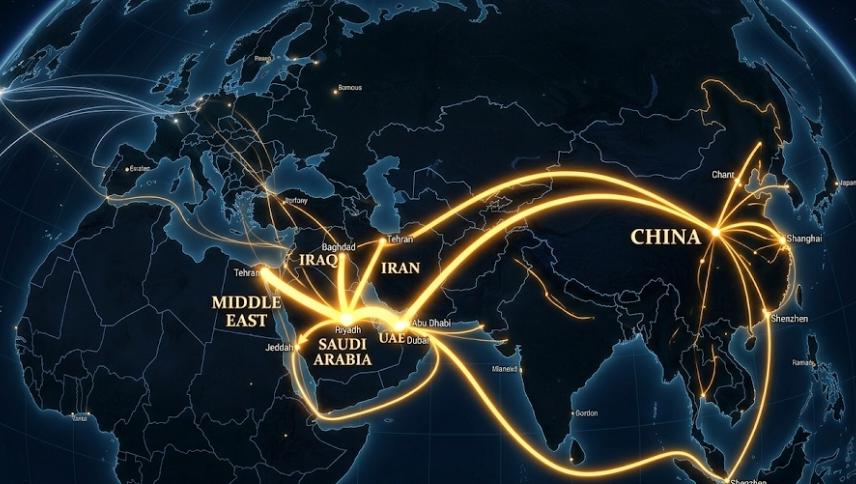
China’s economic footprint in the Middle East has expanded sharply over the past two decades, with investment, construction activity and trade flows pointing to a deepening relationship across the region.
Since 2005, Chinese spending on investments and construction contracts in the Middle East has reached more than $269 billion. Saudi Arabia has received the largest share at around $82 billion, followed by the United Arab Emirates with $48 billion and Iraq with $40 billion. Iran has also attracted notable Chinese involvement, with investments and contracts totalling about $25 billion.
Trade figures reflect a similar trajectory. Commerce between China and the Middle East has more than doubled since 2017, reaching $317 billion in 2024. By comparison, the region’s trade with the United States stands at roughly $85 billion over the same period, highlighting a widening gap in economic engagement.
The scale of activity points to China’s long-term focus on the region, driven in part by energy demand and infrastructure partnerships. Middle Eastern economies, many of which are seeking to diversify beyond oil, have also found value in Chinese capital and project delivery.
At the same time, the growing ties raise questions about balance and dependence. Closer economic links can offer stability and funding for large-scale projects, though they may also increase exposure to shifts in policy or market conditions on either side.
For now, the numbers show a relationship that has moved well beyond trade alone, with investment and construction reinforcing China’s position as a central economic partner in the Middle East.