DFINITY-backed Pakistan national messenger enters testing phase
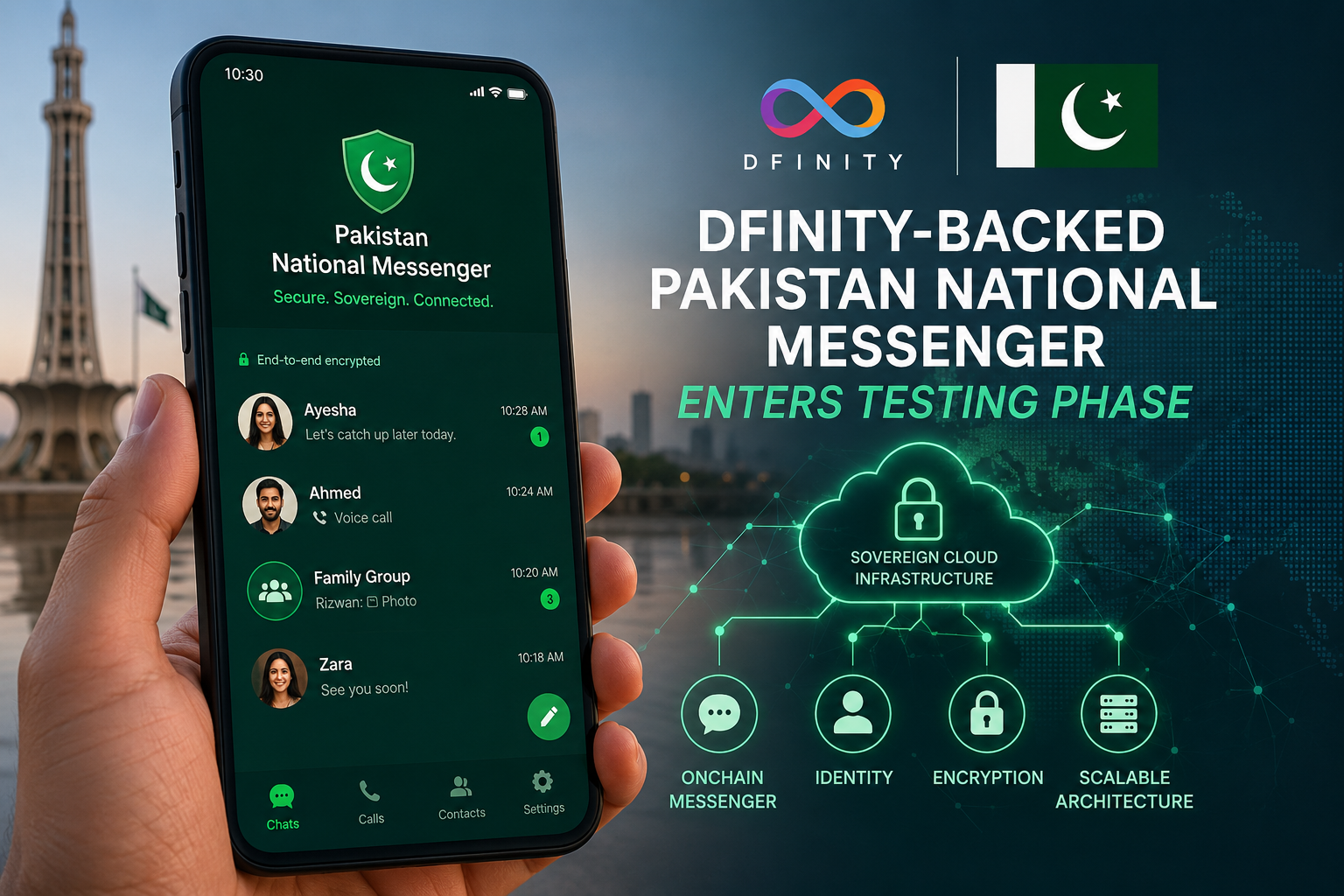
A national messenger application being developed for Pakistan has moved into testing, with the service now running on the country’s dedicated cloud infrastructure and being trialled by a smaller group of users.
Pierre Samaties, who is involved in the project, said on X that the application is being tested through native iOS and Android apps. He described the early version as smooth and clean, while pointing to the combination of sovereign cloud infrastructure, messaging, identity, encryption and a scaling architecture designed for the project.
The messenger is part of a wider digital infrastructure partnership between the Pakistan Digital Authority and the DFINITY Foundation announced in February. The agreement includes plans for a dedicated Pakistan Subnet on the Internet Computer, intended to support national-scale applications while keeping sensitive data within Pakistan. It also includes the development of a national messenger for private and verifiable communications.
Samaties said experience gained from OpenChat has also contributed to the development of the new application. OpenChat is an established messaging service running on the Internet Computer, with features including direct messaging, groups, communities, voice and video calls, and mobile access. Its architecture uses separate canisters for users and group chats, a design intended to support large-scale usage.
The decision to build a separate national service rather than simply adopt OpenChat was raised by a user responding to Samaties’ post. The commenter questioned why Pakistan had not chosen OpenChat, which is already an operational messaging platform.
Samaties offered two reasons. First, he said the national service is intended to have its own rules, design choices and functionality. Second, he said it requires a different scaling architecture.
That distinction is important because OpenChat already provides many of the core functions expected from a modern messaging service. Its platform is community governed and open source, while its current service supports both web and mobile users. Its development repository also remains active, with updates recorded as recently as August 2026.
The Pakistan project therefore appears to be taking lessons from an existing application while adapting the underlying approach to a national deployment. The aim is not simply to reproduce an existing chat service, but to develop one around Pakistan’s own infrastructure and requirements.
The proposed Pakistan Subnet is central to that approach. According to the Pakistan Digital Authority, the infrastructure is intended to reduce reliance on foreign cloud providers and provide a platform for applications and AI systems that can operate under national control. The national messenger is being piloted alongside other initiatives involving AI development and digital infrastructure.
The project is still at the testing stage, so details about its eventual public release, user numbers, governance arrangements and final feature set have yet to be established. Samaties’ comments indicate that native mobile applications are already being tested, suggesting the development has progressed beyond an early concept or demonstration.
For Pakistan, the project forms part of a broader push towards locally controlled digital infrastructure. For the Internet Computer community, it is also an example of how an existing technology platform can be adapted for a national use case rather than relying solely on a general-purpose application.
The next phase will likely provide a clearer picture of how the messenger performs at scale and which features will distinguish it from established services such as OpenChat and conventional messaging platforms.