KIP v2 proposes open protocol for persistent AI memory
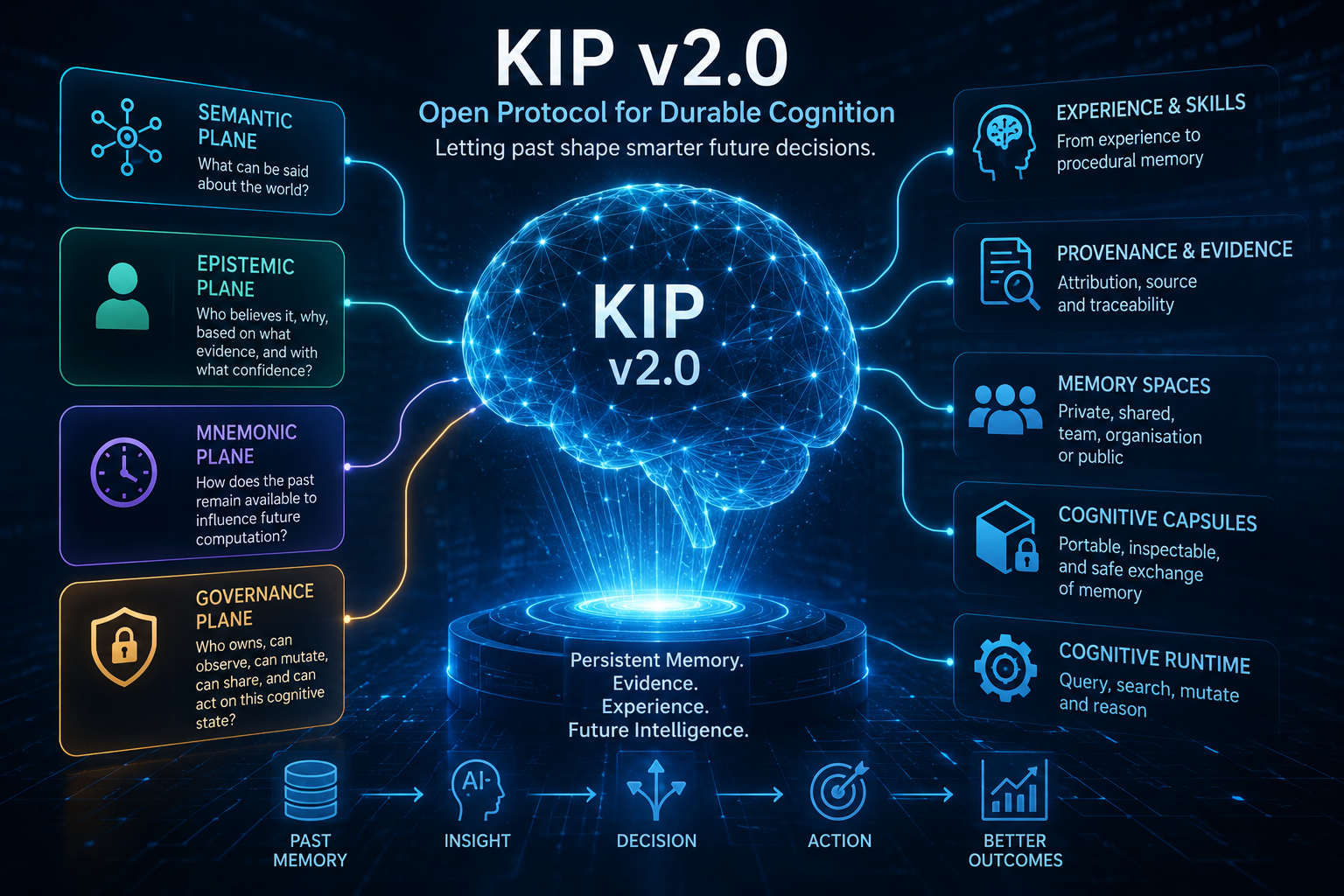
KIP v2 has been made public with a broader goal than its earlier version: creating an open protocol that allows AI agents to retain evidence, beliefs, experiences and learned skills so that past information can influence future behaviour.
KIP, which began as a protocol for connecting large language models with persistent knowledge, now describes its central concept as an agent’s external cognitive state rather than simply a knowledge graph. The architecture is designed around the idea that AI systems need a durable memory layer that can evolve over time while retaining information about where that information came from.
The KIP 2.0 architecture identifies four connected areas: semantic information, the basis for beliefs and assertions, memory, and governance. Together, these are intended to address what an AI system knows, why it should consider something credible, how past experience remains available, and who has authority over the stored information.
One of the main changes from KIP 1.x is the separation of propositions from assertions. Under the proposed model, a proposition is a truth-neutral statement, while an assertion represents an actor’s position towards that statement. This allows different sources to support, reject or remain uncertain about the same proposition without forcing the system to overwrite conflicting information.
The distinction is intended to make AI memory easier to audit. Evidence can be attached to assertions, while provenance records can show how information entered the system. The architecture also separates claimed provenance from the engine’s own record of who submitted information, through which channel and transaction.
KIP v2 also treats memory differently from simple data storage or retrieval. Its architecture defines memory as the ability of past cognitive state to influence future computation or behaviour. It distinguishes memory strength from confidence, trust, salience and utility, arguing that these measures answer different questions and should not be treated as interchangeable.
Experience and skills form another part of the proposed system. An experience records a state, action and observation trajectory, while a skill represents experience that has been developed into a reusable procedure or action policy. The design gives failed experiences a place in memory as well, since failures can provide information about invalid assumptions, recovery strategies and conditions under which a procedure should not be used.
Security is another focus of the architecture. KIP v2 proposes governance boundaries called MemorySpaces, with policies controlling ownership, access, imports, exports and retention. It also proposes that imported executable memory should remain inactive until it has been reviewed or validated. The architecture states that provenance or a cryptographic signature should not automatically be treated as proof that information is true, safe or appropriate for a particular task.
The protocol also proposes Cognitive Capsules for moving cognitive state between systems. These would be designed to preserve schema information, assertions, evidence, provenance and policy-related information while allowing imported material to be inspected before it is merged into another memory space.
For developers, the proposed architecture retains several elements from KIP 1.x, including model-first interaction, graph-based structures, schema introspection, search, atomic writes and portable knowledge capsules. KIP v2 adds areas such as atomic multi-command transactions, capability negotiation, schema packages, provenance tracking and change streams.
The project also makes a distinction between the protocol and the AI system using it. KIP Core is intended to provide the underlying data, governance and runtime primitives, while a Cognitive Memory Profile can define structures such as events, experiences, commitments and skills. The architecture leaves higher-level decisions around memory formation, retrieval, consolidation and learning to an agent’s cognitive runtime or “Brain”.
The document also makes clear that KIP v2 is not intended to reproduce human cognition or store hidden model reasoning. It does not prescribe a particular database, embedding model, confidence formula or forgetting algorithm. Instead, it aims to provide a common protocol layer on which different memory systems can be built.
The published material describes the architecture as informative rather than the final normative specification, with the KIP 2.0 specification taking precedence where the two differ.
The broader proposition behind KIP v2 is that persistent AI memory needs to retain more than information. It needs context about evidence, provenance, confidence, ownership and past experience. If implemented as proposed, KIP v2 would give developers a standardised way to build AI systems whose stored experiences can continue to shape later computation and behaviour, while keeping authority and accountability separate from the information itself.