Swiss healthcare data emerges as potential use case for ICP cloud infrastructure
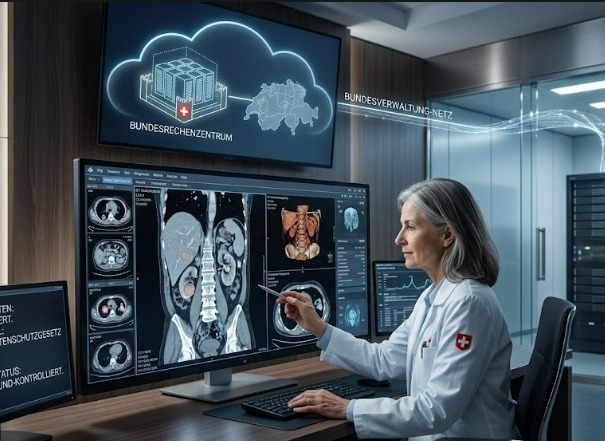
Swiss healthcare providers are being identified as a potential use case for decentralised cloud infrastructure, as hospitals face strict requirements around the handling of sensitive patient information and the use of artificial intelligence.
Robert Pasicko, who leads the United Nations Development Programme’s Alternative Finance Lab, has pointed to medical imaging as one possible application for a UNDP pilot involving decentralised AI and cloud infrastructure. The proposed use case could involve analysing medical scans from about 200,000 patients while keeping sensitive health data under government control.
The comments come as the Swiss Subnet and DFINITY Foundation are being linked to efforts to explore how cloud infrastructure built on the Internet Computer could support organisations that require greater control over where data is stored and processed.
The idea reflects a wider concern among governments and public institutions about dependence on large technology providers for cloud and AI services. Pasicko told Axios that some governments are increasingly interested in using AI while retaining control over sensitive government and citizen data. The UNDP pilots are intended to assess factors including cost, ease of use and whether the technology is suitable for wider deployment.
Healthcare is a particularly sensitive area in Switzerland. Medical records are treated as sensitive personal data under Swiss data protection law, while hospitals can also be subject to different federal or cantonal rules depending on their status. The Swiss Federal Data Protection and Information Commissioner says existing data protection legislation applies directly to AI-supported data processing and requires appropriate safeguards where high-risk processing is involved.
Swiss medical guidance also recommends that doctors favour locally hosted or controlled AI systems when handling sensitive information. The Swiss Medical Association, FMH, says patient data should only be entered into AI systems when technical and legal safeguards ensure controlled processing that complies with Swiss data protection requirements.
That does not mean hospitals in Switzerland are categorically unable to use commercial AI services such as Claude. Anthropic currently offers healthcare-focused Claude services and a HIPAA-ready enterprise offering, although HIPAA is a US healthcare privacy framework and does not itself establish compliance with Swiss requirements. Anthropic also provides regional processing options through certain cloud platforms.
The more relevant issue for Swiss healthcare providers is therefore where patient information is processed, which organisation controls it, what contractual and technical safeguards are in place, and whether the arrangement meets Swiss data protection and professional secrecy requirements.
Swiss authorities are continuing to develop their approach to AI. Switzerland currently has no overarching AI law, although the federal government is preparing legislation linked to the Council of Europe’s AI Convention, with consultation work planned for later in 2026. Data protection rules already apply to AI systems, however, meaning healthcare organisations cannot treat AI deployments as outside existing privacy obligations.
Against this backdrop, cloud infrastructure that allows sensitive workloads to remain under the control of a hospital, government or other institution could offer an alternative architecture for certain applications. Whether such systems can meet the security, performance, governance and regulatory requirements of healthcare will need to be established through individual deployments rather than assumed from the underlying technology.
According to information cited in the claim, onboarding of a large healthcare provider is already under way, although the organisation involved has not been publicly identified. That detail could not be independently verified from publicly available sources at the time of publication.
The proposed medical imaging application also remains a use case rather than evidence of a completed large-scale deployment. For hospitals, the practical test will be whether an alternative cloud model can process demanding medical workloads while giving institutions the control over sensitive data that Swiss rules and healthcare practice require.
The development places Swiss healthcare among a broader set of potential public-sector applications being considered for decentralised AI and cloud infrastructure, while leaving the final question of adoption to hospitals, regulators and technology providers.
Dear Reader,
Ledger Life is an independent platform dedicated to covering the Internet Computer (ICP) ecosystem and beyond. We focus on real stories, builder updates, project launches, and the quiet innovations that often get missed.
We’re not backed by sponsors. We rely on readers like you.
If you find value in what we publish—whether it’s deep dives into dApps, explainers on decentralised tech, or just keeping track of what’s moving in Web3—please consider making a donation. It helps us cover costs, stay consistent, and remain truly independent.
Your support goes a long way.
🧠 ICP Principal: ins6i-d53ug-zxmgh-qvum3-r3pvl-ufcvu-bdyon-ovzdy-d26k3-lgq2v-3qe
🧾 ICP Address: f8deb966878f8b83204b251d5d799e0345ea72b8e62e8cf9da8d8830e1b3b05f
Every contribution helps keep the lights on, the stories flowing, and the crypto clutter out.
Thank you for reading, sharing, and being part of this experiment in decentralised media.
—Team Ledger Life