
India–US Trade Deal: Call It What It Is — A Strategic Failure Wrapped as Success

Let’s stop pretending.

The recent trade deal between India and the United States is being sold as a “positive reset” and a “pragmatic win”. In reality, it exposes a serious failure of trade strategy, followed by a forced surrender dressed up as diplomacy.

This is not negotiation strength.
This is damage control.
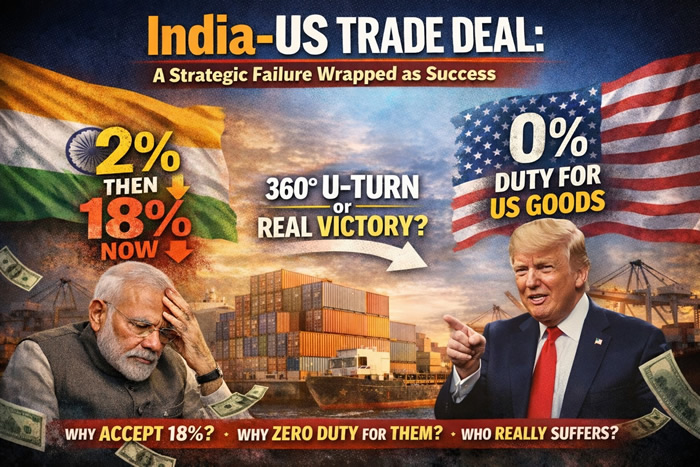
India–US Trade Deal

First, the uncomfortable truth: we already had a better deal

Before all this drama:

  • Indian exports to the US faced 2–3% tariffs
  • Indian products were competitive
  • Exporters had predictability

After confrontation, escalation, and chest-thumping:

  • Tariffs shot up to 25–50%
  • Exporters suffered
  • Jobs were lost
  • MSMEs struggled

Now the government proudly announces:

“Tariffs reduced to 18%”

Let’s be blunt:
18% is NOT a victory. It is still extremely high.

If you start at 2%, fall into a hole at 50%, and then climb back to 18% —
you don’t celebrate. You ask who pushed you into the hole.

The biggest red flag: Zero duty for US products

Here’s where the deal becomes indefensible.

  • Indian goods to US: 18% duty
  • US goods into India: 0% or near-zero duty

This is not reciprocity.
This is imbalance.

How exactly are Indian manufacturers, farmers, and MSMEs supposed to compete with:

  • Heavily subsidised US products
  • Cheaper imports
  • Stronger US brands with scale advantage?

If this is “strategic partnership”, then India is clearly the junior partner.

A full 360° government U-turn

The government first took a hard stand.
Then tariffs exploded.
Then exporters screamed.
Then markets reacted.
Then jobs were threatened.

Finally — the government turned 360° and accepted a deal worse than what we already had.

And now, instead of accountability, we get:

  • Marketing slogans
  • Selective data
  • Victory headlines

Professionals should see through this.

This is not strategic patience.
This is policy miscalculation corrected under pressure.

Who really pays the price? Ordinary Indians

This deal will not hurt the elite. It will hurt:

  • Export-dependent workers
  • Small manufacturers
  • Local traders
  • MSMEs

Yes, some US imports may become cheaper.
But cheaper imports today mean:

  • Closed factories tomorrow
  • Fewer jobs
  • Lower bargaining power for Indian labour

Consumers may save a little.
Producers will lose a lot.

IT industry: Stop overhyping it

Let’s kill another myth.

This deal does nothing meaningful for the IT sector:

  • No visa relief
  • No digital trade framework
  • No data localisation clarity

At best, IT firms get sentiment relief, not structural benefit.
At worst, a stronger rupee cuts margins further.

Calling this an “IT boost” is pure spin.

Crypto & fintech: Absolutely no substance

For crypto and fintech:

  • No tax relief
  • No regulatory clarity
  • No cross-border innovation framework

Any market optimism is emotional, not policy-driven.

The deal gives crypto confidence vibes, not confidence rules.

The question the government refuses to answer

Let professionals ask what matters:

  • If 2–3% tariffs were possible earlier, why accept 18% now?
  • If US goods get 0% duty, where is equal access?
  • If this is a success, why were exporters bleeding for months?

Stability after self-created chaos is not leadership.
It is course correction after failure.

Final word: Don’t clap for a downgrade

This trade deal:

  • Avoids further damage — yes
  • Restores some stability — yes
  • Improves a bad situation — maybe

But it is still worse than what India already had.

Calling it a “win” insults professionals who understand numbers.
Real leadership would admit mistakes, not rebrand them.

India deserves trade policy built on foresight — not firefighting.

LEAVE A REPLY

Please enter your comment!
Please enter your name here

More like this

Caffeine users turn prompts into playable games and practical...

An idea posted by a Caffeine community member quickly moved from chat to a working game, highlighting...

ICP Builder Warns Mission 70 Gas Hike Risks Driving...

An active builder @SnassyIcp on the Internet Computer has spoken out against the first stage of Mission...

Early ICP Builder Arjaan Buijk Recognised for Advancing ‘Proof...

A post circulating within the Internet Computer community has drawn attention to Arjaan Buijk, described as one...

Let’s stop pretending.

The recent trade deal between India and the United States is being sold as a “positive reset” and a “pragmatic win”. In reality, it exposes a serious failure of trade strategy, followed by a forced surrender dressed up as diplomacy.

This is not negotiation strength.
This is damage control.

India–US Trade Deal

First, the uncomfortable truth: we already had a better deal

Before all this drama:

  • Indian exports to the US faced 2–3% tariffs
  • Indian products were competitive
  • Exporters had predictability

After confrontation, escalation, and chest-thumping:

  • Tariffs shot up to 25–50%
  • Exporters suffered
  • Jobs were lost
  • MSMEs struggled

Now the government proudly announces:

“Tariffs reduced to 18%”

Let’s be blunt:
18% is NOT a victory. It is still extremely high.

If you start at 2%, fall into a hole at 50%, and then climb back to 18% —
you don’t celebrate. You ask who pushed you into the hole.

The biggest red flag: Zero duty for US products

Here’s where the deal becomes indefensible.

  • Indian goods to US: 18% duty
  • US goods into India: 0% or near-zero duty

This is not reciprocity.
This is imbalance.

How exactly are Indian manufacturers, farmers, and MSMEs supposed to compete with:

  • Heavily subsidised US products
  • Cheaper imports
  • Stronger US brands with scale advantage?

If this is “strategic partnership”, then India is clearly the junior partner.

A full 360° government U-turn

The government first took a hard stand.
Then tariffs exploded.
Then exporters screamed.
Then markets reacted.
Then jobs were threatened.

Finally — the government turned 360° and accepted a deal worse than what we already had.

And now, instead of accountability, we get:

  • Marketing slogans
  • Selective data
  • Victory headlines

Professionals should see through this.

This is not strategic patience.
This is policy miscalculation corrected under pressure.

Who really pays the price? Ordinary Indians

This deal will not hurt the elite. It will hurt:

  • Export-dependent workers
  • Small manufacturers
  • Local traders
  • MSMEs

Yes, some US imports may become cheaper.
But cheaper imports today mean:

  • Closed factories tomorrow
  • Fewer jobs
  • Lower bargaining power for Indian labour

Consumers may save a little.
Producers will lose a lot.

IT industry: Stop overhyping it

Let’s kill another myth.

This deal does nothing meaningful for the IT sector:

  • No visa relief
  • No digital trade framework
  • No data localisation clarity

At best, IT firms get sentiment relief, not structural benefit.
At worst, a stronger rupee cuts margins further.

Calling this an “IT boost” is pure spin.

Crypto & fintech: Absolutely no substance

For crypto and fintech:

  • No tax relief
  • No regulatory clarity
  • No cross-border innovation framework

Any market optimism is emotional, not policy-driven.

The deal gives crypto confidence vibes, not confidence rules.

The question the government refuses to answer

Let professionals ask what matters:

  • If 2–3% tariffs were possible earlier, why accept 18% now?
  • If US goods get 0% duty, where is equal access?
  • If this is a success, why were exporters bleeding for months?

Stability after self-created chaos is not leadership.
It is course correction after failure.

Final word: Don’t clap for a downgrade

This trade deal:

  • Avoids further damage — yes
  • Restores some stability — yes
  • Improves a bad situation — maybe

But it is still worse than what India already had.

Calling it a “win” insults professionals who understand numbers.
Real leadership would admit mistakes, not rebrand them.

India deserves trade policy built on foresight — not firefighting.

LEAVE A REPLY

Please enter your comment!
Please enter your name here

More like this

Caffeine users turn prompts into playable games and practical...

An idea posted by a Caffeine community member quickly moved from chat to a working game, highlighting...

ICP Builder Warns Mission 70 Gas Hike Risks Driving...

An active builder @SnassyIcp on the Internet Computer has spoken out against the first stage of Mission...

Early ICP Builder Arjaan Buijk Recognised for Advancing ‘Proof...

A post circulating within the Internet Computer community has drawn attention to Arjaan Buijk, described as one...

Let’s stop pretending.

The recent trade deal between India and the United States is being sold as a “positive reset” and a “pragmatic win”. In reality, it exposes a serious failure of trade strategy, followed by a forced surrender dressed up as diplomacy.

This is not negotiation strength.
This is damage control.

India–US Trade Deal

First, the uncomfortable truth: we already had a better deal

Before all this drama:

  • Indian exports to the US faced 2–3% tariffs
  • Indian products were competitive
  • Exporters had predictability

After confrontation, escalation, and chest-thumping:

  • Tariffs shot up to 25–50%
  • Exporters suffered
  • Jobs were lost
  • MSMEs struggled

Now the government proudly announces:

“Tariffs reduced to 18%”

Let’s be blunt:
18% is NOT a victory. It is still extremely high.

If you start at 2%, fall into a hole at 50%, and then climb back to 18% —
you don’t celebrate. You ask who pushed you into the hole.

The biggest red flag: Zero duty for US products

Here’s where the deal becomes indefensible.

  • Indian goods to US: 18% duty
  • US goods into India: 0% or near-zero duty

This is not reciprocity.
This is imbalance.

How exactly are Indian manufacturers, farmers, and MSMEs supposed to compete with:

  • Heavily subsidised US products
  • Cheaper imports
  • Stronger US brands with scale advantage?

If this is “strategic partnership”, then India is clearly the junior partner.

A full 360° government U-turn

The government first took a hard stand.
Then tariffs exploded.
Then exporters screamed.
Then markets reacted.
Then jobs were threatened.

Finally — the government turned 360° and accepted a deal worse than what we already had.

And now, instead of accountability, we get:

  • Marketing slogans
  • Selective data
  • Victory headlines

Professionals should see through this.

This is not strategic patience.
This is policy miscalculation corrected under pressure.

Who really pays the price? Ordinary Indians

This deal will not hurt the elite. It will hurt:

  • Export-dependent workers
  • Small manufacturers
  • Local traders
  • MSMEs

Yes, some US imports may become cheaper.
But cheaper imports today mean:

  • Closed factories tomorrow
  • Fewer jobs
  • Lower bargaining power for Indian labour

Consumers may save a little.
Producers will lose a lot.

IT industry: Stop overhyping it

Let’s kill another myth.

This deal does nothing meaningful for the IT sector:

  • No visa relief
  • No digital trade framework
  • No data localisation clarity

At best, IT firms get sentiment relief, not structural benefit.
At worst, a stronger rupee cuts margins further.

Calling this an “IT boost” is pure spin.

Crypto & fintech: Absolutely no substance

For crypto and fintech:

  • No tax relief
  • No regulatory clarity
  • No cross-border innovation framework

Any market optimism is emotional, not policy-driven.

The deal gives crypto confidence vibes, not confidence rules.

The question the government refuses to answer

Let professionals ask what matters:

  • If 2–3% tariffs were possible earlier, why accept 18% now?
  • If US goods get 0% duty, where is equal access?
  • If this is a success, why were exporters bleeding for months?

Stability after self-created chaos is not leadership.
It is course correction after failure.

Final word: Don’t clap for a downgrade

This trade deal:

  • Avoids further damage — yes
  • Restores some stability — yes
  • Improves a bad situation — maybe

But it is still worse than what India already had.

Calling it a “win” insults professionals who understand numbers.
Real leadership would admit mistakes, not rebrand them.

India deserves trade policy built on foresight — not firefighting.

LEAVE A REPLY

Please enter your comment!
Please enter your name here

More like this

Caffeine users turn prompts into playable games and practical...

An idea posted by a Caffeine community member quickly moved from chat to a working game, highlighting...

ICP Builder Warns Mission 70 Gas Hike Risks Driving...

An active builder @SnassyIcp on the Internet Computer has spoken out against the first stage of Mission...

Early ICP Builder Arjaan Buijk Recognised for Advancing ‘Proof...

A post circulating within the Internet Computer community has drawn attention to Arjaan Buijk, described as one...

Let’s stop pretending.

The recent trade deal between India and the United States is being sold as a “positive reset” and a “pragmatic win”. In reality, it exposes a serious failure of trade strategy, followed by a forced surrender dressed up as diplomacy.

This is not negotiation strength.
This is damage control.

India–US Trade Deal

First, the uncomfortable truth: we already had a better deal

Before all this drama:

  • Indian exports to the US faced 2–3% tariffs
  • Indian products were competitive
  • Exporters had predictability

After confrontation, escalation, and chest-thumping:

  • Tariffs shot up to 25–50%
  • Exporters suffered
  • Jobs were lost
  • MSMEs struggled

Now the government proudly announces:

“Tariffs reduced to 18%”

Let’s be blunt:
18% is NOT a victory. It is still extremely high.

If you start at 2%, fall into a hole at 50%, and then climb back to 18% —
you don’t celebrate. You ask who pushed you into the hole.

The biggest red flag: Zero duty for US products

Here’s where the deal becomes indefensible.

  • Indian goods to US: 18% duty
  • US goods into India: 0% or near-zero duty

This is not reciprocity.
This is imbalance.

How exactly are Indian manufacturers, farmers, and MSMEs supposed to compete with:

  • Heavily subsidised US products
  • Cheaper imports
  • Stronger US brands with scale advantage?

If this is “strategic partnership”, then India is clearly the junior partner.

A full 360° government U-turn

The government first took a hard stand.
Then tariffs exploded.
Then exporters screamed.
Then markets reacted.
Then jobs were threatened.

Finally — the government turned 360° and accepted a deal worse than what we already had.

And now, instead of accountability, we get:

  • Marketing slogans
  • Selective data
  • Victory headlines

Professionals should see through this.

This is not strategic patience.
This is policy miscalculation corrected under pressure.

Who really pays the price? Ordinary Indians

This deal will not hurt the elite. It will hurt:

  • Export-dependent workers
  • Small manufacturers
  • Local traders
  • MSMEs

Yes, some US imports may become cheaper.
But cheaper imports today mean:

  • Closed factories tomorrow
  • Fewer jobs
  • Lower bargaining power for Indian labour

Consumers may save a little.
Producers will lose a lot.

IT industry: Stop overhyping it

Let’s kill another myth.

This deal does nothing meaningful for the IT sector:

  • No visa relief
  • No digital trade framework
  • No data localisation clarity

At best, IT firms get sentiment relief, not structural benefit.
At worst, a stronger rupee cuts margins further.

Calling this an “IT boost” is pure spin.

Crypto & fintech: Absolutely no substance

For crypto and fintech:

  • No tax relief
  • No regulatory clarity
  • No cross-border innovation framework

Any market optimism is emotional, not policy-driven.

The deal gives crypto confidence vibes, not confidence rules.

The question the government refuses to answer

Let professionals ask what matters:

  • If 2–3% tariffs were possible earlier, why accept 18% now?
  • If US goods get 0% duty, where is equal access?
  • If this is a success, why were exporters bleeding for months?

Stability after self-created chaos is not leadership.
It is course correction after failure.

Final word: Don’t clap for a downgrade

This trade deal:

  • Avoids further damage — yes
  • Restores some stability — yes
  • Improves a bad situation — maybe

But it is still worse than what India already had.

Calling it a “win” insults professionals who understand numbers.
Real leadership would admit mistakes, not rebrand them.

India deserves trade policy built on foresight — not firefighting.

LEAVE A REPLY

Please enter your comment!
Please enter your name here

More like this

Caffeine users turn prompts into playable games and practical...

An idea posted by a Caffeine community member quickly moved from chat to a working game, highlighting...

ICP Builder Warns Mission 70 Gas Hike Risks Driving...

An active builder @SnassyIcp on the Internet Computer has spoken out against the first stage of Mission...

Early ICP Builder Arjaan Buijk Recognised for Advancing ‘Proof...

A post circulating within the Internet Computer community has drawn attention to Arjaan Buijk, described as one...