AI Tokens Explained: Utility, Hype, and Long-Term Value
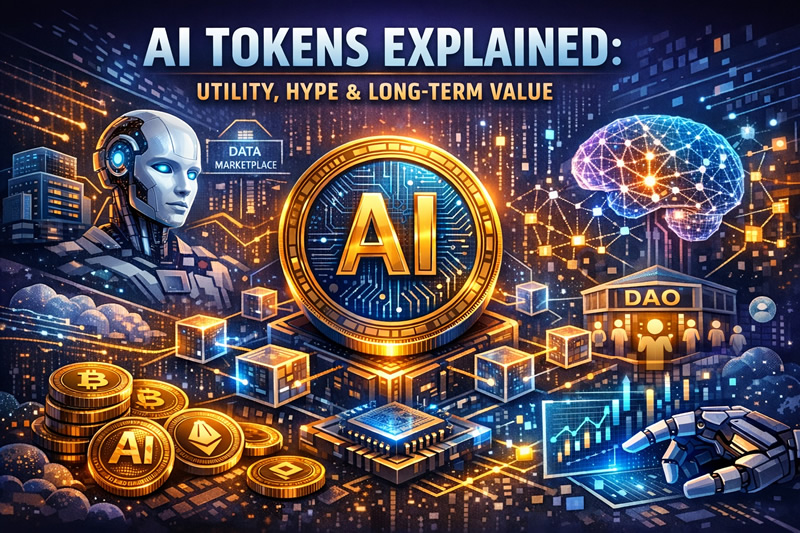
Artificial intelligence (AI) and blockchain are two of the most influential technologies shaping the future of the internet. As these technologies converge, a new crypto category has emerged: AI tokens. Promoted as the backbone of decentralized intelligence, AI tokens claim to power autonomous agents, data economies, and next-generation Web3 applications.
But an important question remains:
Do AI tokens deliver real utility, or are they driven mainly by hype?
This article explores what AI tokens actually are, where they provide real value, where speculation dominates, and how to evaluate their long-term potential.
What Are AI Tokens?
AI tokens are cryptocurrencies designed to support, govern, or incentivize AI-powered systems within decentralized ecosystems. Unlike traditional crypto tokens focused mainly on payments or DeFi, AI tokens are closely tied to:
- Machine learning models
- Data marketplaces
- Decentralized compute networks
- Autonomous AI agents
In simple terms, AI tokens act as economic fuel for intelligent Web3 systems.
They are commonly used to:
- Pay for AI computation and inference
- Reward data providers and model contributors
- Govern AI protocols through DAOs
- Enable AI agents to transact autonomously on-chain
Core Utility Areas of AI Tokens
1. Decentralized AI Compute Infrastructure
Training and running AI models requires significant computing power. AI tokens enable decentralized compute networks, where individuals and organizations contribute GPU or CPU resources instead of relying on centralized cloud providers.
Why this matters:
- Reduces reliance on Big Tech infrastructure
- Lowers costs for AI development
- Improves censorship resistance
Tokens are used to compensate compute providers and secure network participation.
2. AI Data Marketplaces
Data is the foundation of effective AI models. AI tokens incentivize users to share, monetize, and control their data while maintaining transparency and ownership.
Token-based data markets allow:
- Payment for access to datasets
- Rewards for verified, high-quality data
- Traceable data provenance on-chain
This aligns closely with Web3’s user-owned data philosophy.
3. Autonomous AI Agents
One of the most promising applications is the rise of autonomous AI agents capable of interacting directly with blockchain networks.
These agents can:
- Hold crypto wallets
- Execute smart contracts
- Trade assets or manage liquidity
- Pay transaction fees using AI tokens
This enables machine-to-machine economies, a concept not possible in traditional financial systems.
4. Governance of AI Protocols
Many AI-focused projects use decentralized governance. Token holders participate in decisions related to:
- Model upgrades
- Ethical constraints
- Revenue distribution
- Data usage policies
This introduces transparency and accountability into AI development, replacing centralized decision-making with community oversight.
The Hype Around AI Tokens
Despite strong potential, the AI token space is also heavily influenced by speculation.
Common Hype Indicators
- Tokens labeled “AI-powered” with minimal real AI functionality
- Heavy use of buzzwords like AGI, autonomous, or self-learning
- Rapid price increases driven by market narratives rather than adoption
In many cases, the token exists before the technology, increasing long-term risk.
Why Speculation Is So Intense
AI tokens sit at the intersection of two high-growth narratives:
- Artificial intelligence innovation
- Crypto market volatility
This combination attracts attention, capital, and short-term speculation—often before products are fully built.
How to Evaluate Long-Term Value
To identify AI tokens with sustainable potential, consider the following criteria:
1. Real-World Usage
Ask:
- Is the AI system live or in active use?
- Is the token required to access the product?
- Are there real users or enterprise integrations?
2. Clear and Necessary Token Utility
Strong AI tokens have built-in demand, such as:
- Mandatory payment for AI services or compute
- Staking requirements for access or governance
- Incentives tied directly to system performance
If the platform works without the token, its value may be questionable.
3. Sustainable Tokenomics
Evaluate:
- Token supply and inflation rates
- Incentives for long-term holders and contributors
- Alignment between developers, users, and token holders
Poor token economics often lead to value erosion once hype fades.
4. Technical Credibility
Legitimate AI projects typically offer:
- Open-source code or transparent architecture
- Technical documentation and benchmarks
- Evidence of ongoing development
Marketing-heavy projects with little technical output should be approached cautiously.
AI Tokens vs Traditional Crypto Tokens
| Feature | Traditional Crypto Tokens | AI Tokens |
|---|---|---|
| Primary Role | Payments, DeFi, governance | Intelligence, data, compute |
| Demand Driver | Network transactions | AI service consumption |
| Participants | Humans | Humans and machines |
| Growth Potential | Financial adoption | Financial + technological adoption |
This dual adoption path gives AI tokens unique upside, but also greater complexity and risk.
The Future of AI Tokens
AI tokens represent a shift toward decentralized intelligence economies. As AI systems become more autonomous and Web3 infrastructure matures, these tokens could support:
- Decentralized AI marketplaces
- Autonomous financial agents
- Trustless data-sharing ecosystems
- Machine-driven digital labor
However, only projects with real utility, strong governance, and ethical design are likely to endure.