AI Copilots for Web3 Development: What’s Working Today

Web3 development has always demanded a rare mix of skills—blockchain fundamentals, cryptography, smart contract logic, front-end frameworks, and security awareness. Today, AI copilots are stepping in as powerful assistants, helping developers build faster, write cleaner code, and reduce costly mistakes.

But beyond the hype, a key question matters most:
Which AI copilots are actually useful for Web3 development today?

This article explores how AI copilots are being used right now in real Web3 workflows, what they do well, where they fall short, and how they are changing the future of blockchain development.

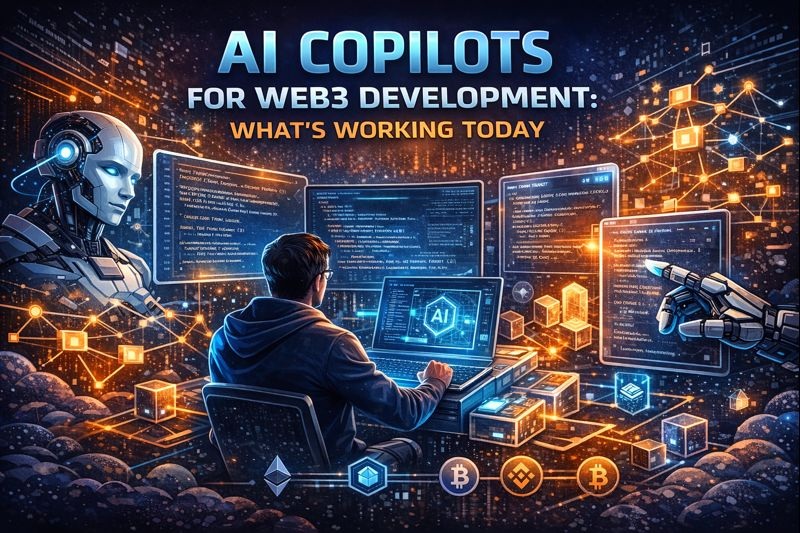
AI Copilots for Web3 Development What’s Working Today


What Are AI Copilots in Web3?

AI copilots are AI-powered development assistants that help developers by:

  • Generating and completing code
  • Explaining complex logic
  • Debugging errors
  • Suggesting optimizations
  • Speeding up testing and documentation

In Web3, these copilots go a step further by assisting with:

  • Smart contract development (Solidity, Rust, Move)
  • Blockchain integrations
  • DeFi logic and token standards
  • Security checks and audits

They don’t replace developers—but they augment productivity and reduce friction.

Where AI Copilots Are Working Today

1. Smart Contract Development

AI copilots are already effective at:

  • Writing boilerplate smart contracts
  • Implementing token standards (ERC-20, ERC-721, ERC-1155)
  • Explaining contract logic line by line
  • Suggesting gas optimizations

Developers use them to accelerate initial development, not to blindly deploy production code.

What works well today:

  • Contract templates
  • Function logic generation
  • Code explanation and refactoring

What still needs human oversight:

  • Business logic correctness
  • Edge cases
  • Security-critical decisions

2. Code Review and Debugging

AI copilots are increasingly used as first-pass reviewers:

  • Identifying common vulnerabilities
  • Explaining compiler errors
  • Flagging reentrancy risks or unsafe patterns

While they don’t replace professional audits, they help developers catch mistakes early, reducing time and cost before formal reviews.


3. Front-End Web3 Integration

Connecting wallets, smart contracts, and user interfaces can be complex. AI copilots assist with:

  • Wallet integrations (MetaMask, WalletConnect)
  • Writing Web3.js / Ethers.js logic
  • Handling transaction flows and error states

This is one area where AI copilots are especially effective, as much of the work follows repeatable patterns.


4. Testing and Documentation

AI copilots help by:

  • Generating unit tests for smart contracts
  • Writing basic test cases for edge scenarios
  • Creating developer documentation and comments

This improves code maintainability—a critical but often neglected part of Web3 projects.


Where AI Copilots Still Struggle

Despite rapid progress, AI copilots have clear limitations.

1. Deep Protocol Design

AI struggles with:

  • Designing new consensus mechanisms
  • Creating novel tokenomics
  • Architecting complex Layer 2 or cross-chain systems

These require human judgment, experience, and creativity.


2. Security Guarantees

AI copilots can suggest fixes, but they:

  • May miss subtle attack vectors
  • Cannot fully understand economic exploits
  • Cannot guarantee contract safety

Blindly trusting AI-generated smart contracts is still risky.


3. Rapidly Changing Web3 Standards

Web3 evolves fast. AI copilots sometimes:

  • Use outdated libraries
  • Reference deprecated methods
  • Miss recent protocol updates

Developers must always validate outputs against current documentation.


Benefits for Web3 Teams

AI copilots are already delivering measurable value:

  • ⚡ Faster development cycles
  • 🧠 Lower learning curve for new developers
  • 🛠️ Reduced boilerplate work
  • 📉 Fewer early-stage bugs
  • 📚 Better documentation quality

For startups and lean teams, this can mean shipping weeks earlier.


AI Copilots vs Traditional Development

Area Traditional Web3 Dev With AI Copilots
Coding Speed Manual, time-intensive Assisted, faster
Learning Curve Steep Reduced
Debugging Trial-and-error Guided suggestions
Documentation Often skipped Auto-assisted
Security Manual checks Early AI screening

AI copilots don’t remove complexity—but they make it more manageable.


The Bigger Picture: What This Means for Web3

AI copilots are quietly reshaping Web3 development by:

  • Democratizing access to blockchain building
  • Enabling faster experimentation
  • Lowering costs for startups
  • Allowing developers to focus on architecture, not syntax

In the long run, this shift may accelerate innovation across DeFi, NFTs, DAOs, and on-chain AI systems.

AI copilots for Web3 development are no longer experimental—they are already working today. While they are not replacements for skilled developers or security auditors, they have become powerful collaborators in the development process.

The teams that use AI copilots wisely—as assistants, not decision-makers—will move faster, build better, and adapt more quickly in an increasingly competitive Web3 ecosystem.

LEAVE A REPLY

Please enter your comment!
Please enter your name here

More like this

Claude code security enters research preview to help teams...

Claude Code Security has been introduced in a limited research preview, offering organisations a new way to...

ClawNow Launches Cloud-Based OpenClaw Access With Multi-Model AI Support

ClawNow has been introduced as a cloud-hosted version of OpenClaw, designed to run continuously and reduce the...
Human + AI The 2027 Shift

AI in 2027: How Artificial Intelligence Will Change Our...

Artificial Intelligence is no longer a concept of the future. It is already shaping our present. But...

Web3 development has always demanded a rare mix of skills—blockchain fundamentals, cryptography, smart contract logic, front-end frameworks, and security awareness. Today, AI copilots are stepping in as powerful assistants, helping developers build faster, write cleaner code, and reduce costly mistakes.

But beyond the hype, a key question matters most:
Which AI copilots are actually useful for Web3 development today?

This article explores how AI copilots are being used right now in real Web3 workflows, what they do well, where they fall short, and how they are changing the future of blockchain development.

AI Copilots for Web3 Development What’s Working Today


What Are AI Copilots in Web3?

AI copilots are AI-powered development assistants that help developers by:

  • Generating and completing code
  • Explaining complex logic
  • Debugging errors
  • Suggesting optimizations
  • Speeding up testing and documentation

In Web3, these copilots go a step further by assisting with:

  • Smart contract development (Solidity, Rust, Move)
  • Blockchain integrations
  • DeFi logic and token standards
  • Security checks and audits

They don’t replace developers—but they augment productivity and reduce friction.

Where AI Copilots Are Working Today

1. Smart Contract Development

AI copilots are already effective at:

  • Writing boilerplate smart contracts
  • Implementing token standards (ERC-20, ERC-721, ERC-1155)
  • Explaining contract logic line by line
  • Suggesting gas optimizations

Developers use them to accelerate initial development, not to blindly deploy production code.

What works well today:

  • Contract templates
  • Function logic generation
  • Code explanation and refactoring

What still needs human oversight:

  • Business logic correctness
  • Edge cases
  • Security-critical decisions

2. Code Review and Debugging

AI copilots are increasingly used as first-pass reviewers:

  • Identifying common vulnerabilities
  • Explaining compiler errors
  • Flagging reentrancy risks or unsafe patterns

While they don’t replace professional audits, they help developers catch mistakes early, reducing time and cost before formal reviews.


3. Front-End Web3 Integration

Connecting wallets, smart contracts, and user interfaces can be complex. AI copilots assist with:

  • Wallet integrations (MetaMask, WalletConnect)
  • Writing Web3.js / Ethers.js logic
  • Handling transaction flows and error states

This is one area where AI copilots are especially effective, as much of the work follows repeatable patterns.


4. Testing and Documentation

AI copilots help by:

  • Generating unit tests for smart contracts
  • Writing basic test cases for edge scenarios
  • Creating developer documentation and comments

This improves code maintainability—a critical but often neglected part of Web3 projects.


Where AI Copilots Still Struggle

Despite rapid progress, AI copilots have clear limitations.

1. Deep Protocol Design

AI struggles with:

  • Designing new consensus mechanisms
  • Creating novel tokenomics
  • Architecting complex Layer 2 or cross-chain systems

These require human judgment, experience, and creativity.


2. Security Guarantees

AI copilots can suggest fixes, but they:

  • May miss subtle attack vectors
  • Cannot fully understand economic exploits
  • Cannot guarantee contract safety

Blindly trusting AI-generated smart contracts is still risky.


3. Rapidly Changing Web3 Standards

Web3 evolves fast. AI copilots sometimes:

  • Use outdated libraries
  • Reference deprecated methods
  • Miss recent protocol updates

Developers must always validate outputs against current documentation.


Benefits for Web3 Teams

AI copilots are already delivering measurable value:

  • ⚡ Faster development cycles
  • 🧠 Lower learning curve for new developers
  • 🛠️ Reduced boilerplate work
  • 📉 Fewer early-stage bugs
  • 📚 Better documentation quality

For startups and lean teams, this can mean shipping weeks earlier.


AI Copilots vs Traditional Development

Area Traditional Web3 Dev With AI Copilots
Coding Speed Manual, time-intensive Assisted, faster
Learning Curve Steep Reduced
Debugging Trial-and-error Guided suggestions
Documentation Often skipped Auto-assisted
Security Manual checks Early AI screening

AI copilots don’t remove complexity—but they make it more manageable.


The Bigger Picture: What This Means for Web3

AI copilots are quietly reshaping Web3 development by:

  • Democratizing access to blockchain building
  • Enabling faster experimentation
  • Lowering costs for startups
  • Allowing developers to focus on architecture, not syntax

In the long run, this shift may accelerate innovation across DeFi, NFTs, DAOs, and on-chain AI systems.

AI copilots for Web3 development are no longer experimental—they are already working today. While they are not replacements for skilled developers or security auditors, they have become powerful collaborators in the development process.

The teams that use AI copilots wisely—as assistants, not decision-makers—will move faster, build better, and adapt more quickly in an increasingly competitive Web3 ecosystem.

LEAVE A REPLY

Please enter your comment!
Please enter your name here

More like this

Claude code security enters research preview to help teams...

Claude Code Security has been introduced in a limited research preview, offering organisations a new way to...

ClawNow Launches Cloud-Based OpenClaw Access With Multi-Model AI Support

ClawNow has been introduced as a cloud-hosted version of OpenClaw, designed to run continuously and reduce the...
Human + AI The 2027 Shift

AI in 2027: How Artificial Intelligence Will Change Our...

Artificial Intelligence is no longer a concept of the future. It is already shaping our present. But...

Web3 development has always demanded a rare mix of skills—blockchain fundamentals, cryptography, smart contract logic, front-end frameworks, and security awareness. Today, AI copilots are stepping in as powerful assistants, helping developers build faster, write cleaner code, and reduce costly mistakes.

But beyond the hype, a key question matters most:
Which AI copilots are actually useful for Web3 development today?

This article explores how AI copilots are being used right now in real Web3 workflows, what they do well, where they fall short, and how they are changing the future of blockchain development.

AI Copilots for Web3 Development What’s Working Today


What Are AI Copilots in Web3?

AI copilots are AI-powered development assistants that help developers by:

  • Generating and completing code
  • Explaining complex logic
  • Debugging errors
  • Suggesting optimizations
  • Speeding up testing and documentation

In Web3, these copilots go a step further by assisting with:

  • Smart contract development (Solidity, Rust, Move)
  • Blockchain integrations
  • DeFi logic and token standards
  • Security checks and audits

They don’t replace developers—but they augment productivity and reduce friction.

Where AI Copilots Are Working Today

1. Smart Contract Development

AI copilots are already effective at:

  • Writing boilerplate smart contracts
  • Implementing token standards (ERC-20, ERC-721, ERC-1155)
  • Explaining contract logic line by line
  • Suggesting gas optimizations

Developers use them to accelerate initial development, not to blindly deploy production code.

What works well today:

  • Contract templates
  • Function logic generation
  • Code explanation and refactoring

What still needs human oversight:

  • Business logic correctness
  • Edge cases
  • Security-critical decisions

2. Code Review and Debugging

AI copilots are increasingly used as first-pass reviewers:

  • Identifying common vulnerabilities
  • Explaining compiler errors
  • Flagging reentrancy risks or unsafe patterns

While they don’t replace professional audits, they help developers catch mistakes early, reducing time and cost before formal reviews.


3. Front-End Web3 Integration

Connecting wallets, smart contracts, and user interfaces can be complex. AI copilots assist with:

  • Wallet integrations (MetaMask, WalletConnect)
  • Writing Web3.js / Ethers.js logic
  • Handling transaction flows and error states

This is one area where AI copilots are especially effective, as much of the work follows repeatable patterns.


4. Testing and Documentation

AI copilots help by:

  • Generating unit tests for smart contracts
  • Writing basic test cases for edge scenarios
  • Creating developer documentation and comments

This improves code maintainability—a critical but often neglected part of Web3 projects.


Where AI Copilots Still Struggle

Despite rapid progress, AI copilots have clear limitations.

1. Deep Protocol Design

AI struggles with:

  • Designing new consensus mechanisms
  • Creating novel tokenomics
  • Architecting complex Layer 2 or cross-chain systems

These require human judgment, experience, and creativity.


2. Security Guarantees

AI copilots can suggest fixes, but they:

  • May miss subtle attack vectors
  • Cannot fully understand economic exploits
  • Cannot guarantee contract safety

Blindly trusting AI-generated smart contracts is still risky.


3. Rapidly Changing Web3 Standards

Web3 evolves fast. AI copilots sometimes:

  • Use outdated libraries
  • Reference deprecated methods
  • Miss recent protocol updates

Developers must always validate outputs against current documentation.


Benefits for Web3 Teams

AI copilots are already delivering measurable value:

  • ⚡ Faster development cycles
  • 🧠 Lower learning curve for new developers
  • 🛠️ Reduced boilerplate work
  • 📉 Fewer early-stage bugs
  • 📚 Better documentation quality

For startups and lean teams, this can mean shipping weeks earlier.


AI Copilots vs Traditional Development

Area Traditional Web3 Dev With AI Copilots
Coding Speed Manual, time-intensive Assisted, faster
Learning Curve Steep Reduced
Debugging Trial-and-error Guided suggestions
Documentation Often skipped Auto-assisted
Security Manual checks Early AI screening

AI copilots don’t remove complexity—but they make it more manageable.


The Bigger Picture: What This Means for Web3

AI copilots are quietly reshaping Web3 development by:

  • Democratizing access to blockchain building
  • Enabling faster experimentation
  • Lowering costs for startups
  • Allowing developers to focus on architecture, not syntax

In the long run, this shift may accelerate innovation across DeFi, NFTs, DAOs, and on-chain AI systems.

AI copilots for Web3 development are no longer experimental—they are already working today. While they are not replacements for skilled developers or security auditors, they have become powerful collaborators in the development process.

The teams that use AI copilots wisely—as assistants, not decision-makers—will move faster, build better, and adapt more quickly in an increasingly competitive Web3 ecosystem.

LEAVE A REPLY

Please enter your comment!
Please enter your name here

More like this

Claude code security enters research preview to help teams...

Claude Code Security has been introduced in a limited research preview, offering organisations a new way to...

ClawNow Launches Cloud-Based OpenClaw Access With Multi-Model AI Support

ClawNow has been introduced as a cloud-hosted version of OpenClaw, designed to run continuously and reduce the...
Human + AI The 2027 Shift

AI in 2027: How Artificial Intelligence Will Change Our...

Artificial Intelligence is no longer a concept of the future. It is already shaping our present. But...

Web3 development has always demanded a rare mix of skills—blockchain fundamentals, cryptography, smart contract logic, front-end frameworks, and security awareness. Today, AI copilots are stepping in as powerful assistants, helping developers build faster, write cleaner code, and reduce costly mistakes.

But beyond the hype, a key question matters most:
Which AI copilots are actually useful for Web3 development today?

This article explores how AI copilots are being used right now in real Web3 workflows, what they do well, where they fall short, and how they are changing the future of blockchain development.

AI Copilots for Web3 Development What’s Working Today


What Are AI Copilots in Web3?

AI copilots are AI-powered development assistants that help developers by:

  • Generating and completing code
  • Explaining complex logic
  • Debugging errors
  • Suggesting optimizations
  • Speeding up testing and documentation

In Web3, these copilots go a step further by assisting with:

  • Smart contract development (Solidity, Rust, Move)
  • Blockchain integrations
  • DeFi logic and token standards
  • Security checks and audits

They don’t replace developers—but they augment productivity and reduce friction.

Where AI Copilots Are Working Today

1. Smart Contract Development

AI copilots are already effective at:

  • Writing boilerplate smart contracts
  • Implementing token standards (ERC-20, ERC-721, ERC-1155)
  • Explaining contract logic line by line
  • Suggesting gas optimizations

Developers use them to accelerate initial development, not to blindly deploy production code.

What works well today:

  • Contract templates
  • Function logic generation
  • Code explanation and refactoring

What still needs human oversight:

  • Business logic correctness
  • Edge cases
  • Security-critical decisions

2. Code Review and Debugging

AI copilots are increasingly used as first-pass reviewers:

  • Identifying common vulnerabilities
  • Explaining compiler errors
  • Flagging reentrancy risks or unsafe patterns

While they don’t replace professional audits, they help developers catch mistakes early, reducing time and cost before formal reviews.


3. Front-End Web3 Integration

Connecting wallets, smart contracts, and user interfaces can be complex. AI copilots assist with:

  • Wallet integrations (MetaMask, WalletConnect)
  • Writing Web3.js / Ethers.js logic
  • Handling transaction flows and error states

This is one area where AI copilots are especially effective, as much of the work follows repeatable patterns.


4. Testing and Documentation

AI copilots help by:

  • Generating unit tests for smart contracts
  • Writing basic test cases for edge scenarios
  • Creating developer documentation and comments

This improves code maintainability—a critical but often neglected part of Web3 projects.


Where AI Copilots Still Struggle

Despite rapid progress, AI copilots have clear limitations.

1. Deep Protocol Design

AI struggles with:

  • Designing new consensus mechanisms
  • Creating novel tokenomics
  • Architecting complex Layer 2 or cross-chain systems

These require human judgment, experience, and creativity.


2. Security Guarantees

AI copilots can suggest fixes, but they:

  • May miss subtle attack vectors
  • Cannot fully understand economic exploits
  • Cannot guarantee contract safety

Blindly trusting AI-generated smart contracts is still risky.


3. Rapidly Changing Web3 Standards

Web3 evolves fast. AI copilots sometimes:

  • Use outdated libraries
  • Reference deprecated methods
  • Miss recent protocol updates

Developers must always validate outputs against current documentation.


Benefits for Web3 Teams

AI copilots are already delivering measurable value:

  • ⚡ Faster development cycles
  • 🧠 Lower learning curve for new developers
  • 🛠️ Reduced boilerplate work
  • 📉 Fewer early-stage bugs
  • 📚 Better documentation quality

For startups and lean teams, this can mean shipping weeks earlier.


AI Copilots vs Traditional Development

Area Traditional Web3 Dev With AI Copilots
Coding Speed Manual, time-intensive Assisted, faster
Learning Curve Steep Reduced
Debugging Trial-and-error Guided suggestions
Documentation Often skipped Auto-assisted
Security Manual checks Early AI screening

AI copilots don’t remove complexity—but they make it more manageable.


The Bigger Picture: What This Means for Web3

AI copilots are quietly reshaping Web3 development by:

  • Democratizing access to blockchain building
  • Enabling faster experimentation
  • Lowering costs for startups
  • Allowing developers to focus on architecture, not syntax

In the long run, this shift may accelerate innovation across DeFi, NFTs, DAOs, and on-chain AI systems.

AI copilots for Web3 development are no longer experimental—they are already working today. While they are not replacements for skilled developers or security auditors, they have become powerful collaborators in the development process.

The teams that use AI copilots wisely—as assistants, not decision-makers—will move faster, build better, and adapt more quickly in an increasingly competitive Web3 ecosystem.

LEAVE A REPLY

Please enter your comment!
Please enter your name here

More like this

Claude code security enters research preview to help teams...

Claude Code Security has been introduced in a limited research preview, offering organisations a new way to...

ClawNow Launches Cloud-Based OpenClaw Access With Multi-Model AI Support

ClawNow has been introduced as a cloud-hosted version of OpenClaw, designed to run continuously and reduce the...
Human + AI The 2027 Shift

AI in 2027: How Artificial Intelligence Will Change Our...

Artificial Intelligence is no longer a concept of the future. It is already shaping our present. But...