Alexandria Library Rolls Out Token Upgrades and On-Chain App Beta, Minting to Begin Soon
Alexandria Library, a Web3 innovator, is moving ahead with plans to build a creator-owned, decentralised AI and NFT library on the Internet Computer. By promoting open-source models and DAO-governed content, the project aims to reduce reliance on large technology companies and shift control towards its community of users and creators.
The latest update from the team highlights a DeFi refresh and refinements to its NFT marketplace. Alongside these upgrades, new on-chain applications are being tested, signalling steady progress from early concepts towards usable products.
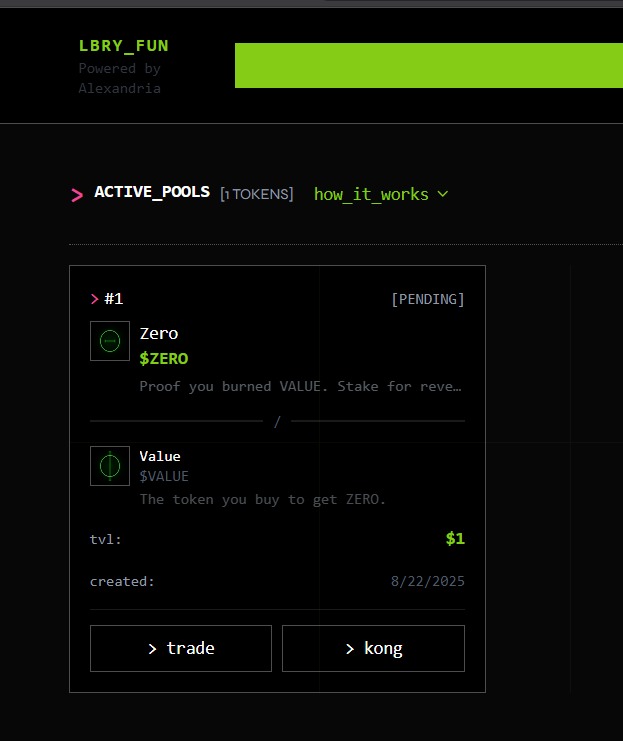
A new token initiative has been announced, introducing a pair named $ZERO and $VALUE. Minting is set to open in just under half a day, with the mechanism described simply as “VALUE accrues to ZERO” and “ZERO earns the yield”. The arrangement hints at a system where one token generates returns for holders of the other, though the practical outcomes will become clearer once testing expands.
There has also been growing attention around $ALEX, which is showing activity in liquidity pools paired with $BOB. While details remain limited, the movement has added an extra layer of anticipation among those following the project’s trajectory.
The developers have invited the community to take part in testing, while making it clear that features are still experimental. Governance remains in the team’s hands for now, with a stated intention to transition towards DAO-controlled canisters once the system matures. This measured approach appears designed to balance innovation with security.
Other recent changes include adjustments to token mechanics to encourage broader participation, such as widening selection pools for community rewards. These shifts suggest a focus on rewarding genuine engagement rather than short-term speculation.
At the same time, the team has cautioned that staking NFTs, holding associated tokens, or providing liquidity outside the platform involves varying levels of risk. The reminder underlines the project’s experimental status, while reinforcing that it remains a work in progress.
Overall, the announcement points to an ongoing effort to refine user experience, introduce new token dynamics, and lay the groundwork for decentralised governance. The language around the launch is deliberately conversational, positioning the update as an invitation for users to test, participate, and help shape what comes next.
Dear Reader,
Ledger Life is an independent platform dedicated to covering the Internet Computer (ICP) ecosystem and beyond. We focus on real stories, builder updates, project launches, and the quiet innovations that often get missed.
We’re not backed by sponsors. We rely on readers like you.
If you find value in what we publish—whether it’s deep dives into dApps, explainers on decentralised tech, or just keeping track of what’s moving in Web3—please consider making a donation. It helps us cover costs, stay consistent, and remain truly independent.
Your support goes a long way.
🧠 ICP Principal: ins6i-d53ug-zxmgh-qvum3-r3pvl-ufcvu-bdyon-ovzdy-d26k3-lgq2v-3qe
🧾 ICP Address: f8deb966878f8b83204b251d5d799e0345ea72b8e62e8cf9da8d8830e1b3b05f
🪙 BTC Wallet: bc1pp5kuez9r2atdmrp4jmu6fxersny4uhnaxyrxau4dg7365je8sy2q9zff6p
Every contribution helps keep the lights on, the stories flowing, and the crypto clutter out.
Thank you for reading, sharing, and being part of this experiment in decentralised media.
—Team Ledger Life