Caffeine AI Week2: NFT Games and Apps in Minutes
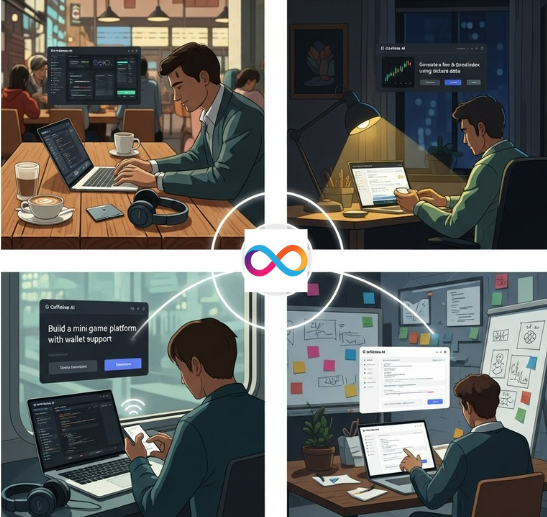
Developers and builders working with the Internet Computer Protocol (ICP) are starting to adopt Caffeine AI to build applications at speed, using plain language prompts rather than traditional code. From Web3 data vaults to real-time card games, financial dashboards and mini-game platforms, early users are discovering how much they can create with relatively little effort—provided they’re comfortable testing, tweaking and working with tools that are still evolving.
Caffeine AI is designed to turn written instructions into working apps, directly deployable on ICP. The tool interprets prompts and assembles functional codebases that live fully on-chain. For some, this lowers the barrier to entry. For others, it’s a way to quickly prototype or build tools that would otherwise require teams of developers. Several early users have shared their projects publicly, and the range of outputs has been surprisingly broad.
Among the more well-publicised launches is EnclaveX, created by the team at Next Block. It’s a Web3 vault for storing passwords, seed phrases and other sensitive data securely on-chain. EnclaveX runs on the ICP network, taking advantage of its decentralised infrastructure to deliver a fast and private experience while removing the need for cloud storage or third-party key management. The developers built the vault using Caffeine AI’s natural language interface and are now seeking feedback from the broader community as they continue to improve its features.
ICP Hub Egypt has showcased rapid AI-driven development with two projects. First, they built an AI-generated card battle game where Caffeine AI handled everything from logic to deployment, keeping track of gameplay and memory without needing constant input. The AI was the lead, producing a working game from a sentence-long prompt. The team sponsored the project enthusiastically. Additionally, in just three prompts and three minutes, they developed a basic 3D first-person shooter game, fully on-chain on ICP. This no-code, no-engine game highlighted the efficiency and creativity possible with modern AI-driven development tools on the Internet Computer blockchain.
Individual builders have also weighed in with their experiences. Markus set out to build a couple of simple games and ended up with a functional minigame platform that includes wallet integration. He worked on it from a phone while commuting by train and said the whole thing came together in around two hours. There were no code editors, no terminals—just a conversation with an AI and a live deployment on ICP. Markus also experimented further, building a personal data storage (PDS) solution on ICP with just one design and one functional prompt. He’s sharing the evolution of this project publicly and has plans for its future development.
Another developer, Fabio, decided to test how fast he could build a basic financial dashboard. Using Token Terminal’s API and feeding prompts into Caffeine AI, he created a functioning Fear & Greed Index app in under 15 minutes. He admits the version is early and lacking full data integration, but the core logic is there, and any initial bugs were handled through follow-up prompts. He plans to continue iterating on it and may release a video walkthrough of the build.
Scott took a different route, creating FairMarketCap.com, a project intended to shine a light on misleading trading activity such as wash trading. Built with the help of Caffeine AI, the site presents data visualisations that aim to tell a more transparent story than some of the more established ranking platforms. It positions ICP within broader market comparisons, while also pointing out where others may manipulate volume or market cap visibility.
Josh Drake, part of the DFINITY team, wanted to see how easily existing templates could be repurposed. He chose a jewellery app from the Caffeine AI marketplace and rebuilt it into a point-of-sale system for a local coffee shop, all with two prompts. He used it to demonstrate how quickly app logic and front-end frameworks could be reoriented without touching the original code.
Then there’s Danz, who built a social tool for saving, organising and sharing prompt content. The app, Caffeine Companion, is already live for testing and allows users to create a profile, save their favourite prompts and see what others are generating. It’s a small project but serves as a useful example of how AI development is starting to intersect with community features and collaborative workflows.
Dexter built Chess Arena, while Westcliff Technologies developed a Face Tracking + AR app in just three prompts and less than five minutes. Setting up face tracking using TensorFlow models is far from trivial. Getting reliable face tracking to work, especially with objects that follow facial movements in real-time, usually requires significant effort coding. Caffeine AI made it look easy.
Trevor Knight developed LunaLink and LunaDrop, a peer-to-peer ICP wallet that enables offline transaction sharing through generated payloads. These can be transmitted via BLE mesh, SMS, or radio. As a bonus, the app doubles as a way to geolocate family or friends in emergencies.
All of these examples show a willingness among early users to experiment, to build fast, and to share their work openly. The apps vary in scope and polish, but the speed at which they were made is one of the key talking points. Whether it’s a game, a vault, a dashboard or a utility tool, many were created in a matter of minutes or hours, not days or weeks.
That said, there are open questions around what parts of the system are decentralised and which still rely on off-chain components. While the final applications run on-chain using ICP canisters, the AI that interprets the user’s prompts is currently hosted off-chain. This has prompted discussion among some users who are more deeply invested in decentralisation principles. The ideal scenario for some would be a version of Caffeine AI where the entire process—from model inference to deployment—lives on-chain. But technical limitations make this a difficult target for now, and most users seem more focused on output and usability than on architectural purism.
There are also technical constraints to consider. Memory limits, data handling, and scalability challenges come with the territory of building fully decentralised apps. These aren’t unique to Caffeine AI or ICP, but they do influence how far users can go with their projects today. Performance can vary depending on the complexity of the prompt and the level of follow-up required. Some users have reported needing multiple iterations to fix logic errors or fill in missing pieces, while others say their builds worked on the first try.
Despite those variables, the overall tone from early users is one of curiosity rather than frustration. Most appear to be approaching the tool with the mindset of exploration rather than production. They are aware they’re working with a product in early development, but the ability to go from concept to live application so quickly is proving useful—especially for testing ideas, validating assumptions, or just learning what’s possible.
The long-term potential of tools like Caffeine AI depends on how well they integrate with developer workflows and how much control they give to users who eventually want to go beyond fast builds into full customisation. If it can scale, remain stable, and add depth over time, it may continue attracting interest from across the Web3 space.
For now, it’s clear that users are finding it useful not because it replaces developers but because it changes how projects get started. A vault, a game, a dashboard, even a coffee shop app—these are practical, working examples of what can be built with natural language and a few well-formed prompts. Whether Caffeine AI becomes part of the everyday toolkit for Web3 builders or remains a niche tool for rapid prototyping will depend on how it evolves. But the early results are showing what happens when you give creators access to powerful infrastructure without asking them to write code first.
Dear Reader,
Ledger Life is an independent platform dedicated to covering the Internet Computer (ICP) ecosystem and beyond. We focus on real stories, builder updates, project launches, and the quiet innovations that often get missed.
We’re not backed by sponsors. We rely on readers like you.
If you find value in what we publish—whether it’s deep dives into dApps, explainers on decentralised tech, or just keeping track of what’s moving in Web3—please consider making a donation. It helps us cover costs, stay consistent, and remain truly independent.
Your support goes a long way.
🧠 ICP Principal: ins6i-d53ug-zxmgh-qvum3-r3pvl-ufcvu-bdyon-ovzdy-d26k3-lgq2v-3qe
🧾 ICP Address: f8deb966878f8b83204b251d5d799e0345ea72b8e62e8cf9da8d8830e1b3b05f
🪙 BTC Wallet: bc1pp5kuez9r2atdmrp4jmu6fxersny4uhnaxyrxau4dg7365je8sy2q9zff6p
Every contribution helps keep the lights on, the stories flowing, and the crypto clutter out.
Thank you for reading, sharing, and being part of this experiment in decentralised media.
—Team Ledger Life