India’s E85 Fuel Revolution: A New Opportunity or a Market Disruption?
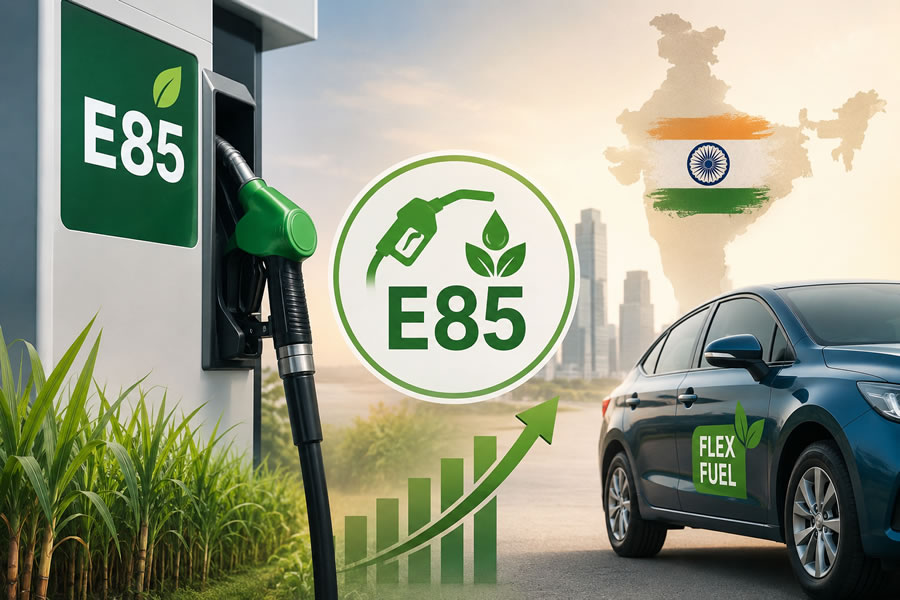
New Delhi: India has taken another significant step toward reducing its dependence on imported crude oil with the introduction of E85 fuel, a high-ethanol blend containing 80-85% ethanol and 15-20% petrol. The move comes alongside the nationwide implementation of E20 fuel and marks a new phase in the country’s transition toward alternative energy solutions.
While E20 fuel has already become available across much of the country and is compatible with many newer petrol vehicles, E85 fuel is designed specifically for Flex-Fuel Vehicles (FFVs), which are engineered to run on varying ethanol concentrations.
The development is expected to create ripple effects across India’s automotive, agriculture, energy, and retail sectors.
A Strategic Move Toward Energy Independence
India remains one of the world’s largest importers of crude oil, with imported fuel accounting for a major share of the country’s energy consumption. Rising global oil prices and ongoing geopolitical uncertainties have increased pressure on policymakers to diversify fuel sources.
By promoting ethanol-based fuels, the government aims to reduce foreign exchange outflows, strengthen energy security, and support domestic industries.
Industry experts believe that higher ethanol adoption could help India lower its oil import bill while accelerating its climate and sustainability goals.
Opportunities for the Automobile Industry
The introduction of E85 creates a new market segment for vehicle manufacturers.
Automakers are expected to increase investments in Flex-Fuel Vehicle technology as demand gradually develops. Manufacturers that adapt quickly could gain an early advantage in what may become an important future segment of the Indian automotive market.
However, the transition will not be immediate. Existing petrol vehicles cannot use E85 unless specifically designed for high-ethanol blends. This means widespread adoption will depend on the availability and affordability of FFVs.
For vehicle manufacturers, the launch represents both an opportunity for innovation and a challenge requiring significant investment in research, engineering, and consumer awareness.
Agriculture Emerges as a Key Beneficiary
Perhaps the biggest winners could be India’s farmers and ethanol producers.
Ethanol production relies heavily on agricultural feedstocks such as sugarcane, maize, and other crops. As fuel demand shifts toward ethanol blends, farmers may benefit from increased demand and more stable pricing for their produce.
The expansion could also encourage investment in rural infrastructure, ethanol processing facilities, and supply chains, creating employment opportunities beyond traditional farming activities.
Several sugar mills are already diversifying into ethanol production, transforming themselves into integrated energy businesses.
Fuel Retailers Face Infrastructure Challenge
Oil marketing companies and fuel station operators will need to adapt to the changing fuel landscape.
The rollout of E85 will require dedicated storage systems, transportation infrastructure, and distribution networks. These upgrades could involve substantial investment, particularly during the initial stages of implementation.
Fuel retailers will also face the task of educating consumers about fuel compatibility and ensuring that E85 is used only in approved Flex-Fuel Vehicles.
Marketing Battle Moves Beyond Price
The launch of E85 is likely to trigger new marketing strategies across the automotive and energy sectors.
Automobile brands may increasingly position Flex-Fuel Vehicles as environmentally responsible alternatives to conventional petrol-powered cars. Fuel companies, meanwhile, could focus on themes such as energy independence, sustainability, and support for Indian farmers.
Consumer education will play a crucial role. Many vehicle owners remain unfamiliar with the differences between E20, E85, hybrid technologies, CNG, and electric vehicles. Companies that simplify these choices and communicate benefits clearly may gain a competitive advantage.
The Pros
Supporters of the initiative point to several advantages:
- Reduced dependence on imported crude oil
- Lower greenhouse gas emissions compared to conventional fuels
- Increased income opportunities for farmers
- Growth of domestic biofuel industries
- Enhanced long-term energy security
The policy also aligns with India’s broader objective of building a greener and more self-reliant economy.
The Concerns
Despite its potential, the E85 rollout is not without challenges.
Critics highlight concerns regarding fuel efficiency, as ethanol generally contains less energy per litre than petrol. This may result in lower mileage for vehicles operating on high-ethanol blends. There are also concerns about water consumption, agricultural land use, and the possibility of diverting crops from food production toward fuel production.
In addition, building the infrastructure required for nationwide E85 distribution could take years and require significant investment.
What Happens Next?
Industry analysts view E85 as part of India’s broader transition strategy rather than an immediate replacement for traditional fuels. E20 is expected to remain the dominant blended fuel for most consumers in the near future, while E85 adoption will likely grow gradually alongside the availability of Flex-Fuel Vehicles.
For businesses, investors, and policymakers, the introduction of E85 represents more than a fuel change. It signals the emergence of a new ethanol-driven economy that could reshape multiple industries over the coming decade. Whether the initiative becomes a major success will depend on consumer adoption, infrastructure readiness, vehicle availability, and the government’s ability to balance energy goals with agricultural sustainability.
For now, India’s fuel market has entered a new chapter—one that could redefine the relationship between agriculture, energy, and transportation in the world’s fastest-growing major economy.