

Home Blog Page 4

Neutron Hackathon opens with focus on user-owned canisters and new licence

0

The Neutron Hackathon has opened, inviting developers to submit applications while putting a longer-term focus on software rights, user control and decentralisation.

According to the organisers, participants can build and submit apps during the hackathon, with rewards including cICP. The organisers have cautioned that the cICP rewards may not be immediately liquid because cICP is tied to a liquid staking arrangement. They said the underlying neuron could be proposed for dissolution, a process expected to take two years, and estimated that the resulting value could be greater than 1.28 ICP per cICP. They also noted that the timing and availability of liquidity is not guaranteed.

Participants therefore have been advised to consider the liquidity limitations before taking part, with the organisers saying developers who do not want the rewards can leave them for others.

The organisers are presenting the larger prize as the opportunity to work with a proposed kernel licence, called the Neutron Software User Public License, or NSUPL.

The proposal draws on ideas from the GNU General Public License, which established a framework allowing software to be used, modified and redistributed while requiring distributed derivative versions to preserve specified freedoms. GPLv3 also introduced provisions addressing so-called “tivoization”, aimed at preventing distributors from using hardware restrictions to stop users from running modified versions of software.

The Neutron proposal seeks to apply a similar principle to user-sovereign canisters. Its stated aim is to establish rules that favour users and application developers while discouraging arrangements in which a party retains control over canisters intended to remain under user control.

The approach reflects a wider question facing decentralised application development: how software licences can protect user control when applications rely on hosted infrastructure and programmable canisters.

Under the proposed NSUPL model, developers would have greater freedom to share, modify and build on software, while the licence would place conditions on attempts to retain centralised control over user-sovereign canisters.

The hackathon therefore combines an immediate developer competition with a broader experiment around how licensing could be used to support decentralised application ownership.

There are also practical considerations for participants. The cICP reward structure involves a long dissolution period, and the organisers have acknowledged that the resulting asset may not be instantly liquid. The value of the reward can also change, meaning participants need to weigh the potential benefit against the conditions attached to it.

The Neutron team describes the licence as the larger prize because it is intended to give developers a framework for building applications where users retain meaningful control over the canisters supporting those applications.

The hackathon is now open for app submissions, giving developers an opportunity to test the proposed approach through working applications rather than through licensing principles alone.


Dear Reader,

Ledger Life is an independent platform dedicated to covering the Internet Computer (ICP) ecosystem and beyond. We focus on real stories, builder updates, project launches, and the quiet innovations that often get missed.

We’re not backed by sponsors. We rely on readers like you.

If you find value in what we publish—whether it’s deep dives into dApps, explainers on decentralised tech, or just keeping track of what’s moving in Web3—please consider making a donation. It helps us cover costs, stay consistent, and remain truly independent.

Your support goes a long way.

🧠 ICP Principal: ins6i-d53ug-zxmgh-qvum3-r3pvl-ufcvu-bdyon-ovzdy-d26k3-lgq2v-3qe

🧾 ICP Address: f8deb966878f8b83204b251d5d799e0345ea72b8e62e8cf9da8d8830e1b3b05f

Every contribution helps keep the lights on, the stories flowing, and the crypto clutter out.

Thank you for reading, sharing, and being part of this experiment in decentralised media.
—Team Ledger Life

KIP v2 proposes open protocol for persistent AI memory

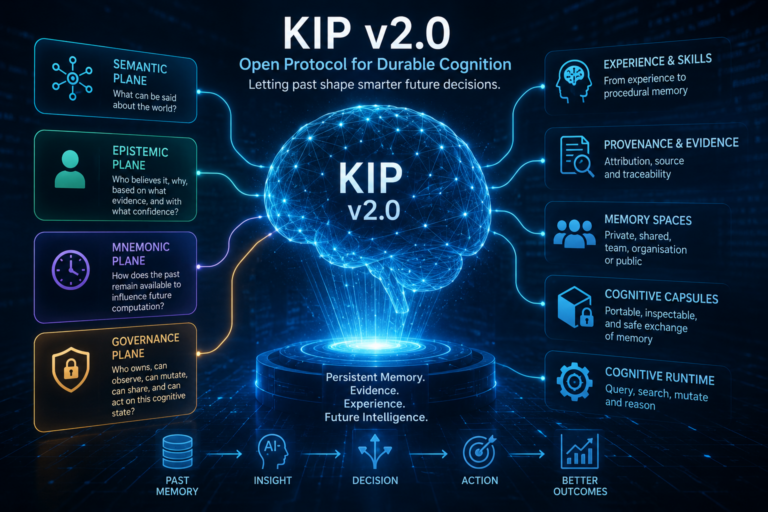
KIP v2 has been made public with a broader goal than its earlier version: creating an open protocol that allows AI agents to retain evidence, beliefs, experiences and learned skills so that past information can influence future behaviour.

KIP, which began as a protocol for connecting large language models with persistent knowledge, now describes its central concept as an agent’s external cognitive state rather than simply a knowledge graph. The architecture is designed around the idea that AI systems need a durable memory layer that can evolve over time while retaining information about where that information came from.

The KIP 2.0 architecture identifies four connected areas: semantic information, the basis for beliefs and assertions, memory, and governance. Together, these are intended to address what an AI system knows, why it should consider something credible, how past experience remains available, and who has authority over the stored information.

One of the main changes from KIP 1.x is the separation of propositions from assertions. Under the proposed model, a proposition is a truth-neutral statement, while an assertion represents an actor’s position towards that statement. This allows different sources to support, reject or remain uncertain about the same proposition without forcing the system to overwrite conflicting information.

The distinction is intended to make AI memory easier to audit. Evidence can be attached to assertions, while provenance records can show how information entered the system. The architecture also separates claimed provenance from the engine’s own record of who submitted information, through which channel and transaction.

KIP v2 also treats memory differently from simple data storage or retrieval. Its architecture defines memory as the ability of past cognitive state to influence future computation or behaviour. It distinguishes memory strength from confidence, trust, salience and utility, arguing that these measures answer different questions and should not be treated as interchangeable.

Experience and skills form another part of the proposed system. An experience records a state, action and observation trajectory, while a skill represents experience that has been developed into a reusable procedure or action policy. The design gives failed experiences a place in memory as well, since failures can provide information about invalid assumptions, recovery strategies and conditions under which a procedure should not be used.

Security is another focus of the architecture. KIP v2 proposes governance boundaries called MemorySpaces, with policies controlling ownership, access, imports, exports and retention. It also proposes that imported executable memory should remain inactive until it has been reviewed or validated. The architecture states that provenance or a cryptographic signature should not automatically be treated as proof that information is true, safe or appropriate for a particular task.

The protocol also proposes Cognitive Capsules for moving cognitive state between systems. These would be designed to preserve schema information, assertions, evidence, provenance and policy-related information while allowing imported material to be inspected before it is merged into another memory space.

For developers, the proposed architecture retains several elements from KIP 1.x, including model-first interaction, graph-based structures, schema introspection, search, atomic writes and portable knowledge capsules. KIP v2 adds areas such as atomic multi-command transactions, capability negotiation, schema packages, provenance tracking and change streams.

The project also makes a distinction between the protocol and the AI system using it. KIP Core is intended to provide the underlying data, governance and runtime primitives, while a Cognitive Memory Profile can define structures such as events, experiences, commitments and skills. The architecture leaves higher-level decisions around memory formation, retrieval, consolidation and learning to an agent’s cognitive runtime or “Brain”.

The document also makes clear that KIP v2 is not intended to reproduce human cognition or store hidden model reasoning. It does not prescribe a particular database, embedding model, confidence formula or forgetting algorithm. Instead, it aims to provide a common protocol layer on which different memory systems can be built.

The published material describes the architecture as informative rather than the final normative specification, with the KIP 2.0 specification taking precedence where the two differ.

The broader proposition behind KIP v2 is that persistent AI memory needs to retain more than information. It needs context about evidence, provenance, confidence, ownership and past experience. If implemented as proposed, KIP v2 would give developers a standardised way to build AI systems whose stored experiences can continue to shape later computation and behaviour, while keeping authority and accountability separate from the information itself.


Dear Reader,

Ledger Life is an independent platform dedicated to covering the Internet Computer (ICP) ecosystem and beyond. We focus on real stories, builder updates, project launches, and the quiet innovations that often get missed.

We’re not backed by sponsors. We rely on readers like you.

If you find value in what we publish—whether it’s deep dives into dApps, explainers on decentralised tech, or just keeping track of what’s moving in Web3—please consider making a donation. It helps us cover costs, stay consistent, and remain truly independent.

Your support goes a long way.

🧠 ICP Principal: ins6i-d53ug-zxmgh-qvum3-r3pvl-ufcvu-bdyon-ovzdy-d26k3-lgq2v-3qe

🧾 ICP Address: f8deb966878f8b83204b251d5d799e0345ea72b8e62e8cf9da8d8830e1b3b05f

Every contribution helps keep the lights on, the stories flowing, and the crypto clutter out.

Thank you for reading, sharing, and being part of this experiment in decentralised media.
—Team Ledger Life

DeFi lending rates draw attention as stablecoin yields and BTC borrowing costs diverge

DeFi lending markets continue to show a wide spread between stablecoin yields and cryptocurrency borrowing costs, with recent figures from Liquidium highlighting the gap between USDC and USDT supply returns and the current cost of borrowing Bitcoin and Ethereum.

As of 10 August 2026, Liquidium listed a USDC supply APY of 2.528% and a USDT supply APY of 2.824%. Borrowing rates were 4.182% for USDC and 4.421% for USDT.

Bitcoin and Ethereum borrowing rates were much lower, at 0.103% and 0.101% respectively.

The difference reflects how DeFi lending markets price assets based on supply, borrowing demand and liquidity. Stablecoin markets often attract borrowers seeking dollar-denominated liquidity, while borrowing rates for BTC and ETH can remain comparatively low depending on utilisation and available liquidity.

Analysts generally caution that headline APY figures can be misleading when viewed in isolation. A higher supply yield may be linked to tighter liquidity conditions or stronger borrowing demand, while a lower borrowing rate may come with different collateral requirements or liquidation risks.

One of the main drivers of rate changes in DeFi lending is utilisation, which measures how much of the supplied liquidity is currently borrowed. As utilisation rises, borrowing costs typically increase, and supplier yields often rise as well.

For lenders, the key considerations usually include liquidity, withdrawal conditions and the source of the yield. Borrowers tend to focus on collateral requirements, loan-to-value ratios, liquidation thresholds and repayment mechanics.

The figures also illustrate the distinction between supplying an asset and borrowing it. A quoted Bitcoin lending rate may refer to the yield earned by supplying BTC or the cost of borrowing BTC, which are separate markets with different dynamics.

Liquidium positions itself as a native cross-chain lending protocol supporting BTC, ETH, ICP and stablecoins. The platform also supports multi-collateral borrowing, including positions backed by native Bitcoin and native Ethereum.

DeFi lending remains a competitive market alongside platforms such as Aave, Compound and Morpho, with rates continuing to change as capital moves between protocols and borrower demand shifts.

For users comparing lending markets, the rate itself is only one part of the equation. Liquidity, collateral structure and liquidation risk often have a greater impact on the overall cost and risk of a lending or borrowing position.

The rates cited are variable and may change with market conditions.


Dear Reader,

Ledger Life is an independent platform dedicated to covering the Internet Computer (ICP) ecosystem and beyond. We focus on real stories, builder updates, project launches, and the quiet innovations that often get missed.

We’re not backed by sponsors. We rely on readers like you.

If you find value in what we publish—whether it’s deep dives into dApps, explainers on decentralised tech, or just keeping track of what’s moving in Web3—please consider making a donation. It helps us cover costs, stay consistent, and remain truly independent.

Your support goes a long way.

🧠 ICP Principal: ins6i-d53ug-zxmgh-qvum3-r3pvl-ufcvu-bdyon-ovzdy-d26k3-lgq2v-3qe

🧾 ICP Address: f8deb966878f8b83204b251d5d799e0345ea72b8e62e8cf9da8d8830e1b3b05f

Every contribution helps keep the lights on, the stories flowing, and the crypto clutter out.

Thank you for reading, sharing, and being part of this experiment in decentralised media.
—Team Ledger Life

Dominic Williams points to passkeys after France home invasion case

Internet Computer founder Dominic Williams has argued that decentralised passkey-based authentication could reduce personal security risks for digital asset holders, following reports of a home invasion in France linked to outdated cryptocurrency ownership information.

Williams made the comments after two men were sentenced by a French court for their role in an attempted home invasion targeting a property that lawyers say had previously been owned by cryptocurrency millionaires.

“The lives of Trezor owners are now at risk,” Williams wrote on social media, referring to concerns that criminals could use leaked personal information to identify and target digital asset holders at their homes.

He argued that Internet Identity, an authentication system introduced on the Internet Computer five years ago, was designed to avoid exposing users to some of the risks associated with traditional credential-based security systems. “Passkeys equal decentralised security,” he said.

The French case has drawn attention because the alleged attackers are believed to have acted on outdated information. Lawyers representing the current owners, a farmer and a bank executive in their twenties, say criminals may have obtained financial details connected to the property’s former owners, a retired couple who reportedly made substantial wealth through cryptocurrency.

According to reports from France, the house was targeted three times between June and July. During the second attack, one occupant was tied up and the other assaulted before the intruders fled. The latest attempted break-in was prevented by an alarm installed after the earlier incidents.

The two men sentenced this week received prison terms of three years and 18 months respectively.

The case has added to broader concerns about so-called “wrench attacks”, in which victims are threatened or assaulted in an attempt to force the transfer of digital assets.

Security researchers have increasingly argued that protecting wallet keys is only one part of the problem. Personal privacy, address exposure and data leaks can become physical security issues when criminals believe an individual may hold valuable digital assets.

Williams’ comments reflect a wider debate within the digital asset industry about whether authentication systems that rely on passkeys, biometrics and cryptographic credentials can offer stronger protection than password-based approaches, particularly when linked to decentralised identity systems.

The French case remains a reminder that security failures can extend beyond technology and into the real world when personal information becomes exposed.


Dear Reader,

Ledger Life is an independent platform dedicated to covering the Internet Computer (ICP) ecosystem and beyond. We focus on real stories, builder updates, project launches, and the quiet innovations that often get missed.

We’re not backed by sponsors. We rely on readers like you.

If you find value in what we publish—whether it’s deep dives into dApps, explainers on decentralised tech, or just keeping track of what’s moving in Web3—please consider making a donation. It helps us cover costs, stay consistent, and remain truly independent.

Your support goes a long way.

🧠 ICP Principal: ins6i-d53ug-zxmgh-qvum3-r3pvl-ufcvu-bdyon-ovzdy-d26k3-lgq2v-3qe

🧾 ICP Address: f8deb966878f8b83204b251d5d799e0345ea72b8e62e8cf9da8d8830e1b3b05f

Every contribution helps keep the lights on, the stories flowing, and the crypto clutter out.

Thank you for reading, sharing, and being part of this experiment in decentralised media.
—Team Ledger Life
Salon booking platform built on ICP expands with AI and WhatsApp integration

A salon booking platform built on the Internet Computer Protocol (ICP) is moving into its next phase, with plans to integrate WhatsApp and an AI agent to handle customer enquiries and appointment bookings.

The update was shared by agriiDAO founder Terry Igharoro, who said the system has already been deployed for a salon and that the next stage will focus on automating customer interactions through WhatsApp.

According to Igharoro, the salon has an existing client base of around 5,000 customers, who will be able to use the new booking and enquiry system without changing the way they already communicate with the business.

The planned AI agent is designed to respond to enquiries, manage bookings and assist with routine customer service tasks through WhatsApp, a platform widely used by many small businesses for appointment scheduling and client communication.

While the announcement did not include details on deployment timelines or technical specifications, it reflects a growing interest among developers in using blockchain-based infrastructure for customer-facing business applications.

Projects built on ICP have increasingly focused on integrating familiar consumer platforms and messaging services, with the aim of reducing barriers to adoption for both businesses and their customers.

For salons and other appointment-based businesses, AI-assisted booking tools are becoming more common as operators look for ways to manage enquiries outside business hours and reduce administrative workload.

The project appears to be an early example of ICP infrastructure being used behind the scenes in a service that customers can access through a mainstream messaging platform.


Dear Reader,

Ledger Life is an independent platform dedicated to covering the Internet Computer (ICP) ecosystem and beyond. We focus on real stories, builder updates, project launches, and the quiet innovations that often get missed.

We’re not backed by sponsors. We rely on readers like you.

If you find value in what we publish—whether it’s deep dives into dApps, explainers on decentralised tech, or just keeping track of what’s moving in Web3—please consider making a donation. It helps us cover costs, stay consistent, and remain truly independent.

Your support goes a long way.

🧠 ICP Principal: ins6i-d53ug-zxmgh-qvum3-r3pvl-ufcvu-bdyon-ovzdy-d26k3-lgq2v-3qe

🧾 ICP Address: f8deb966878f8b83204b251d5d799e0345ea72b8e62e8cf9da8d8830e1b3b05f

Every contribution helps keep the lights on, the stories flowing, and the crypto clutter out.

Thank you for reading, sharing, and being part of this experiment in decentralised media.
—Team Ledger Life

Liquidium expands Ordinals offering with new Robinhood sister collection

Liquidium has announced the launch of a Robinhood sister collection tied to its Machines project, while renewed trading activity has drawn attention back to the original Machines Ordinals collection.

The update encourages holders and traders to use the Machines collection through the Liquidium marketplace, where users can buy listed assets or use their Ordinals holdings in lending and borrowing activities that generate Bitcoin-denominated returns.

Liquidium has positioned the new Robinhood collection as a companion release rather than a replacement for the original Machines series. The company said interest in the launch has led many traders to revisit the earlier collection, which remains active on the platform.

Ordinals collections have become an increasingly visible part of the Bitcoin digital asset market, with platforms competing to offer trading, lending and collateral-based financial services built around Bitcoin-native assets. Liquidium has focused on using Ordinals as collateral for loans and other yield-generating activities within the Bitcoin ecosystem.

The company did not disclose the size of the Robinhood collection or provide further details on future releases. The announcement centred on increasing activity around Machines and expanding participation through Liquidium’s lending infrastructure.

Market interest in Ordinals collections can be highly volatile, with prices and trading volumes often driven by collector demand and broader sentiment across Bitcoin-related digital assets.


Dear Reader,

Ledger Life is an independent platform dedicated to covering the Internet Computer (ICP) ecosystem and beyond. We focus on real stories, builder updates, project launches, and the quiet innovations that often get missed.

We’re not backed by sponsors. We rely on readers like you.

If you find value in what we publish—whether it’s deep dives into dApps, explainers on decentralised tech, or just keeping track of what’s moving in Web3—please consider making a donation. It helps us cover costs, stay consistent, and remain truly independent.

Your support goes a long way.

🧠 ICP Principal: ins6i-d53ug-zxmgh-qvum3-r3pvl-ufcvu-bdyon-ovzdy-d26k3-lgq2v-3qe

🧾 ICP Address: f8deb966878f8b83204b251d5d799e0345ea72b8e62e8cf9da8d8830e1b3b05f

Every contribution helps keep the lights on, the stories flowing, and the crypto clutter out.

Thank you for reading, sharing, and being part of this experiment in decentralised media.
—Team Ledger Life
FomoWell partners with WhatPay to expand Bitcoin asset access

FomoWell has announced a partnership with WhatPay aimed at expanding access to Bitcoin-based digital assets and improving how users discover, manage and trade them.

The collaboration brings together FomoWell’s infrastructure for Bitcoin asset issuance and trading with WhatPay’s AI-native MPC wallet technology. The companies said the partnership is intended to create a more connected environment for Bitcoin asset activity and simplify the user experience for on-chain transactions.

According to the announcement, the two platforms plan to improve how Bitcoin assets are discovered and used, with an emphasis on smoother wallet interactions and asset management tools.

WhatPay’s wallet is designed to provide AI-assisted asset management and on-chain trading functions, while FomoWell focuses on infrastructure supporting the creation and trading of Bitcoin-linked assets.

The companies said they expect the partnership to explore applications involving Bitcoin, artificial intelligence and digital asset infrastructure, although no timeline or specific product integrations were announced.

Partnerships between infrastructure providers and wallet platforms have become increasingly common as companies seek to improve usability and broaden access to decentralised financial services built around Bitcoin and other digital assets.

FomoWell and WhatPay said the collaboration is intended to make Bitcoin assets easier for users to access and use across a wider range of on-chain applications.


Dear Reader,

Ledger Life is an independent platform dedicated to covering the Internet Computer (ICP) ecosystem and beyond. We focus on real stories, builder updates, project launches, and the quiet innovations that often get missed.

We’re not backed by sponsors. We rely on readers like you.

If you find value in what we publish—whether it’s deep dives into dApps, explainers on decentralised tech, or just keeping track of what’s moving in Web3—please consider making a donation. It helps us cover costs, stay consistent, and remain truly independent.

Your support goes a long way.

🧠 ICP Principal: ins6i-d53ug-zxmgh-qvum3-r3pvl-ufcvu-bdyon-ovzdy-d26k3-lgq2v-3qe

🧾 ICP Address: f8deb966878f8b83204b251d5d799e0345ea72b8e62e8cf9da8d8830e1b3b05f

Every contribution helps keep the lights on, the stories flowing, and the crypto clutter out.

Thank you for reading, sharing, and being part of this experiment in decentralised media.
—Team Ledger Life

ICPay launches cloud API keys for automated storage uploads

ICPay has introduced cloud API keys that allow developers to automate file uploads to the Internet Computer without requiring a wallet session or manual approval for each upload.

The new feature is designed for developers and teams managing recurring uploads, application deployments and scheduled file updates. API keys can be created for individual storage buckets and assigned write or delete permissions, with users able to revoke them at any time. ICPay said the secret key is displayed only once during creation.

The company said the feature enables assets to be deployed directly to on-chain storage through CI/CD workflows, while automated processes such as bots and scheduled jobs can update files without manual intervention. Files stored through the service can also be served through public CDN links.

According to ICPay, storage remains encrypted at rest and users can manage up to 10 API keys per bucket. The service continues to use ICP for payments.

API-based access is a common feature across cloud storage platforms, allowing applications and infrastructure tools to interact with storage services programmatically. ICPay’s approach brings that workflow to storage hosted on the Internet Computer, where files are stored on-chain rather than through conventional cloud infrastructure.

The feature is available through the ICPay dashboard, where users can generate and manage bucket-specific keys from the storage interface.


Dear Reader,

Ledger Life is an independent platform dedicated to covering the Internet Computer (ICP) ecosystem and beyond. We focus on real stories, builder updates, project launches, and the quiet innovations that often get missed.

We’re not backed by sponsors. We rely on readers like you.

If you find value in what we publish—whether it’s deep dives into dApps, explainers on decentralised tech, or just keeping track of what’s moving in Web3—please consider making a donation. It helps us cover costs, stay consistent, and remain truly independent.

Your support goes a long way.

🧠 ICP Principal: ins6i-d53ug-zxmgh-qvum3-r3pvl-ufcvu-bdyon-ovzdy-d26k3-lgq2v-3qe

🧾 ICP Address: f8deb966878f8b83204b251d5d799e0345ea72b8e62e8cf9da8d8830e1b3b05f

Every contribution helps keep the lights on, the stories flowing, and the crypto clutter out.

Thank you for reading, sharing, and being part of this experiment in decentralised media.
—Team Ledger Life

ODIN reports busiest development week of the quarter with 187 code commits

ODIN has released its Week 31 development update, reporting 187 code commits and 42 pull requests, making it the project’s busiest development week of the quarter.

The update focuses on infrastructure reliability, security testing, monitoring systems and staking improvements, with several changes aimed at strengthening the platform before wider deployment.

One of the main changes involved the project’s indexing infrastructure. ODIN said both of its indexers now have dedicated health endpoints, allowing the system to verify whether they are functioning correctly before deployments proceed. The event indexer deployment process has been tied to successful health checks, while the staking indexer now uses a watchdog system that separates “alive” and “caught up” status checks. The team also introduced operational monitoring tools, including metrics dashboards, incident routing and a documented runbook for troubleshooting.

The project also disclosed that it conducted an adversarial exploit exercise against its phase-one staking canister before launch. According to the update, the testing identified multiple issues, including findings from the exploit suite, a withdrawal review and a transfer fee accounting problem labelled FEE-1. ODIN said the issue involved a flat 100-satoshi transfer fee that had not been fully accounted for by the canister. The team said all identified issues were resolved before users were affected.

As part of the security changes, production deployments have been restricted to manual approval, and the production environment is now limited to a fixed 27-method allowlist enforced through continuous integration checks.

The update also addressed a SQL injection vulnerability. A temporary escaping patch introduced in the previous week has been replaced with parameter binding, which is generally considered the standard approach for preventing SQL injection attacks. The project said read queries have also been moved to a read replica.

Changes were made to API error handling, with errors now being logged against the originating call rather than a wrapper layer. The update said HTTP responses will now return more accurate status codes instead of defaulting to generic server errors.

ODIN also expanded monitoring across liquidity, withdrawal and transfer operations. The team said incident paging has been limited to production systems, while development and staging environments can no longer trigger operational alerts. No-data alerts have also been adjusted to reduce unnecessary notifications.

Staking duration handling was updated to align with canister timing, with internationalisation support added across the interface. The platform now blocks extension requests once the maximum staking duration has been reached, preventing users from submitting requests that the canister would reject.

The project continues to publish weekly development updates under its “building in public” approach, giving users and developers visibility into engineering progress, operational issues and security work as the platform evolves.


Dear Reader,

Ledger Life is an independent platform dedicated to covering the Internet Computer (ICP) ecosystem and beyond. We focus on real stories, builder updates, project launches, and the quiet innovations that often get missed.

We’re not backed by sponsors. We rely on readers like you.

If you find value in what we publish—whether it’s deep dives into dApps, explainers on decentralised tech, or just keeping track of what’s moving in Web3—please consider making a donation. It helps us cover costs, stay consistent, and remain truly independent.

Your support goes a long way.

🧠 ICP Principal: ins6i-d53ug-zxmgh-qvum3-r3pvl-ufcvu-bdyon-ovzdy-d26k3-lgq2v-3qe

🧾 ICP Address: f8deb966878f8b83204b251d5d799e0345ea72b8e62e8cf9da8d8830e1b3b05f

Every contribution helps keep the lights on, the stories flowing, and the crypto clutter out.

Thank you for reading, sharing, and being part of this experiment in decentralised media.
—Team Ledger Life

Internet Computer expands list of ICP support providers as Julius Bär adds custody service

The Internet Computer has updated its network economics page to include a broader range of exchanges, brokers, banks and custodians that support buying, managing and holding ICP, according to a post on X by Pierre Samaties.

The update gives users a wider view of financial institutions and service providers that offer access to ICP, reflecting the range of channels available for custody and investment services.

Among the additions is Bank Julius Bär & Co. AG, which now offers ICP custody to its clients through a collaboration with AMINA Bank. The arrangement places ICP within the custody services available through the Swiss private banking group.

Custody services have become an important part of digital asset adoption among institutional and private banking clients, particularly where regulated financial institutions are involved. Banks and custodians generally provide safekeeping, reporting and compliance services that differ from self-custody arrangements used by many retail users.

The Internet Computer website update does not indicate a change to the network’s underlying economic model. Instead, it expands the list of institutions that support ICP-related services, making it easier for users to identify providers that offer custody, brokerage or trading access.

Julius Bär has been gradually expanding its digital asset capabilities in recent years through partnerships with specialist firms, while AMINA Bank has focused on regulated digital asset banking and custody services.

The broader list of support providers may improve visibility for institutional and professional investors who prefer accessing digital assets through established financial intermediaries, although the availability of services can vary by jurisdiction and client eligibility requirements.

For ICP users, the update provides a clearer reference point for where custody and investment services are currently available across the banking, brokerage and custodial sectors.


Dear Reader,

Ledger Life is an independent platform dedicated to covering the Internet Computer (ICP) ecosystem and beyond. We focus on real stories, builder updates, project launches, and the quiet innovations that often get missed.

We’re not backed by sponsors. We rely on readers like you.

If you find value in what we publish—whether it’s deep dives into dApps, explainers on decentralised tech, or just keeping track of what’s moving in Web3—please consider making a donation. It helps us cover costs, stay consistent, and remain truly independent.

Your support goes a long way.

🧠 ICP Principal: ins6i-d53ug-zxmgh-qvum3-r3pvl-ufcvu-bdyon-ovzdy-d26k3-lgq2v-3qe

🧾 ICP Address: f8deb966878f8b83204b251d5d799e0345ea72b8e62e8cf9da8d8830e1b3b05f

Every contribution helps keep the lights on, the stories flowing, and the crypto clutter out.

Thank you for reading, sharing, and being part of this experiment in decentralised media.
—Team Ledger Life